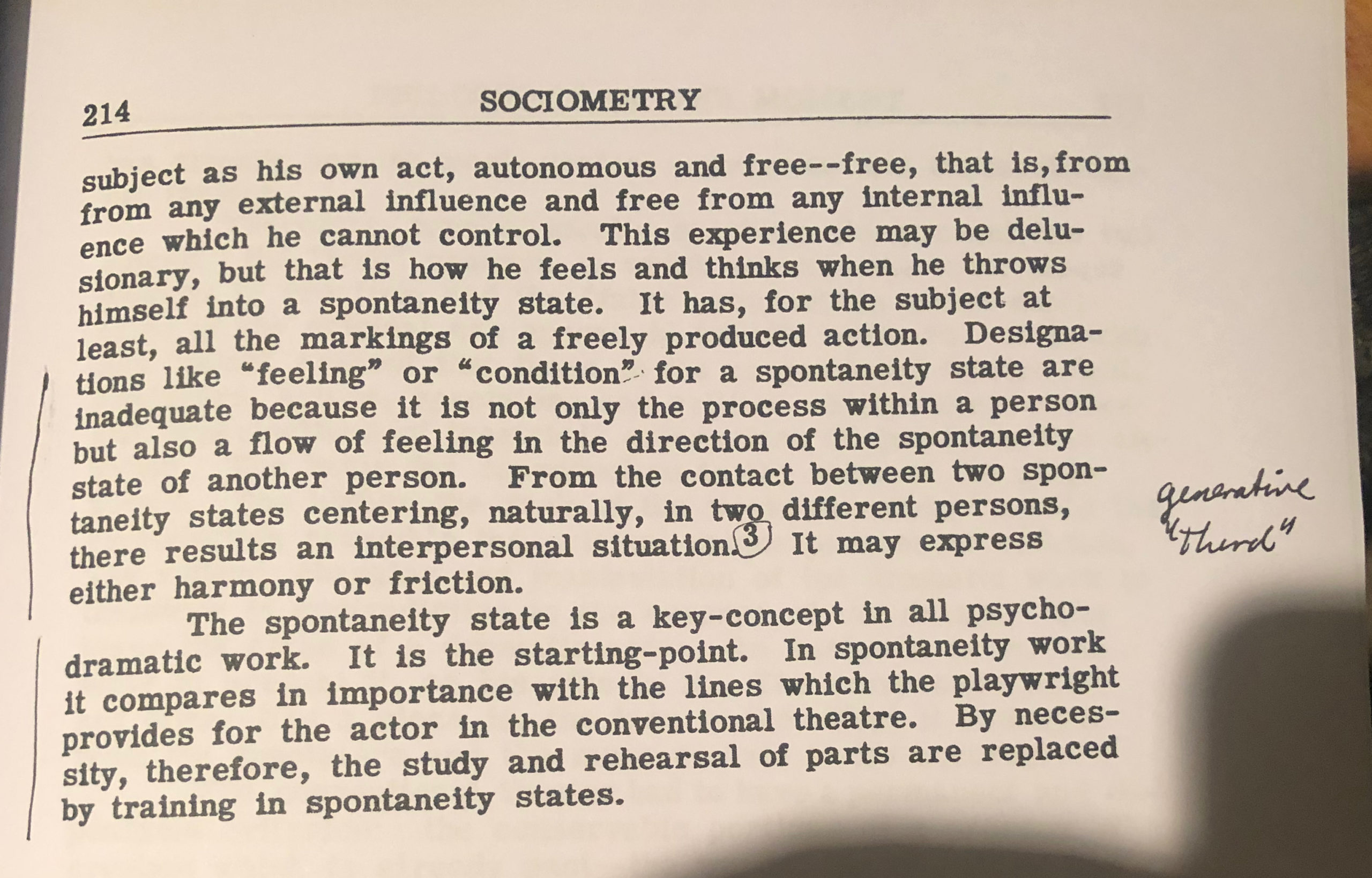
I’m working on a handout on action for a Psychodramatic Couple Therapy Training event in September. Psychodrama is sometimes mistakenly called an “action method”. That might mean people move about. That they exhibit behaviour. The real question is: are they actors? That is, agents in their own life!
The action includes: the body, emotions, thinking, the breath, the spirit, the soul, the chi, life energy, prana. In psychodrama language that is spontaneity-creativity.
Here are two quotes:
The organism-in-environment is a behavioral system; the actor in situ is an actorial system, and, Moreno (1953b) states, it is important to distinguish between the two. A collectivity of actors is a different entity from a collectivity of organisms and has a different meaning.
Warner (1954) points out that from Moreno’s perspective, when one tries to understand behavior by separating an action into components, as the psychologist does, one ends up ignoring the most important characteristics of human behavior, social interaction. Acts, actions, and interactions are complex behaviors that are intended to gain a desired goal. They occur within a cultural context. There is a reciprocal relationship between the members of a group and the group’s culture. On the one hand, it is the actions of the members that create the culture of the group and on the other hand the culture of the group shapes the actions of its members.
Meyer writes, “The heart of Dr. Moreno’s sociometric method is action. Time and again in the writings of this book and elsewhere, he insists that sociometric methods require that individuals cease to be subjects for research, patients in the clinic, or objects of reform. They must become participants” (1952, p. 360). Sociometric research, Moreno insisted, is for the benefit of the people involved, not for the benefit of the researcher. Therefore, the subjects should be included in the design of the research, in the selection of criteria, for example. Sociometry should take place in life, in the real situation of the individuals, not in the
laboratory of the scientist. Unless the sociometric experiment includes an activity in which the group members partake, it is, at best, “near sociometric.” Sociometry is an action method.
John Nolte
It is worth meditating on the words of Moreno — especially how they might apply to couples.
An action matrix registers acts and events . A behavior matrix registers “observations” of acts and events . The actor must become an observer of himself and an actor towards the observer, i.e ., the observer must become an actor towards the observed and an observer of himself ; one must co-act with the other, a meeting is taking place . In an ongoing socio-psychodrama the subjective view of the actor and the objective view of the co-actor are one, they are on the same plane . Indeed, as … auxiliary egos to each other on the plane of action the degree of their reciprocal subjectivities and objectivities are continuously in a process of mixture; A acts towards B, B acts towards A; A observes self and acts towards B, B observes self and acts towards A ; A observes A, B observes B ; A observes A and B, B observes B and A ; A acts towards C, A acts towards B and C, C acts towards B and A, etc . A genuine theory of action and actors deals with actorial categories and interaction potentials like spontaneity, creativity, the warm up, the moment, the meeting, … auxiliary ego and other categories which express the coexperiential level of an actor’s world on the level of action .
Moreno “Who Shall Survive?” p74
Some notes about Action & couple therapy
How does work when we are working with the relationship? The “third entity”?

Not “male female” but role systems — unity of opposites unity and opposites.
The protagonist will transform the and the auxiliary will transform
Action is to do with being actors — active participants.
If there is ambivalence about the relationship — Discernment therapy.
Individuation is always needed