John Markoff Podcasts

IT Conversations: John Markoff (Part 1 of 2) – SDForum Distinguished Speaker Series Great discussion based around the history of computing as put forward in a book by John Markoff: What the Dormouse Said: How the 60s Counterculture Shaped the Personal Computer.

This is a great two part podcast! Listening to it I hear some geniuses time are there talking about an incredible revolution in communication. Many of the people I have blogged about there in the past get a mention – and are there! Doug Englebart is one. Ivan Illich gets a mentionI

This podcasts takes me back to the 60s and I realise how much that counterculture influenced me at the time. It must have been through the Whole Earth Catalogue that I found Illich – and that led to Four Avenues – School Without Walls. It is through this sort of thing that I feel a connection with the nostalgia that comes through in this history.

I really liked the comment that one speaker makes: “We need a Pedagogy of Interactive Media” – wow. I have a real enthusiasm for that. In a way this blog is about that – a psychology of interactive media – my “psyber-” is related and a prerequisite for the pedagogy. A pedagogy can’t be designed without a psychology.

So, I am deeply attuned to the discussions in this podcast and delighted to see how computing emerged in its origins not out of the money culture but the counterculture – people trying to make the world a better place is the key motivation I hear in this podcast. I recommend it.

Albert Ellis

village voice > people > The Interview by Rachel Aviv

Many of your books include charts, questionnaires and equations, which show readers how to more efficiently deal with their unhappiness. Are there dangers in seeing deep mental processes as a formula?
It’s not a formula. It’s several different formulas. I encourage USA, Unconditional Self Acceptance. I accept me, myself, my personality, whether or not I do well. I prefer to do well, but I don’t put my worth on the line. And I accept you—with your [cough attack] stupidity and failings—whether or not you do well. And I accept life, which is bad, without demanding that it be exactly the way I want it to be. I avoid the words ‘should,’ ‘ought’ and ‘must.

As much as I think that CBT, RET or whatever they call it these days is the enemy of the soul and healing (even though “research” shows it is “effective”), my heart goes out to this old bugger. No doubt he is a spunky genius! I like this interview and saved a copy to txt.

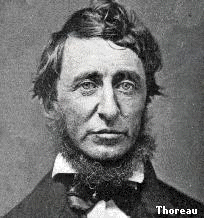
Thoreau

Henry David Thoreau (1817-1862):
A Bio Page for students, with some nice quotes

Sometimes, in a summer morning, having taken my accustomed bath, I sat in my sunny doorway from sunrise to noon, rapt in revery, amidst the pines and hickories and sumachs, while the birds sang or flitted noiseless through the house until by sun falling in at my west window, or the noise of some traveller’ s wagon on the distant highway, I was reminded of the lapse of time. I grew in those seasons like corn in the night, and they were far better than any of the work of the hands would have been. They were not time subtracted from my life, but so much over and above my usual allowance. I realized what the Orientals mean by contemplation and the forsaking of works.’ – ‘Sounds,’ Walden

I notced the link and was drawn to it as I am reading “World’s End” – The Lanny Budd series by Upton Sinclair. (see next entry) People like Thoreau come up and hundreds of others. It’s is history in easy doses. I will keep linking various people as I read, we will get through the whole of the last century that way.

: