The Deceiving Virtues of Technology

An essay by Steve Talbott it is available in NetFuture #125 I have since read it more fully and find I have two points to make (for now): One, it is about technology not cyberspace, which is fine of course, but the latter is so much more probing, and later in the debate this lack of an experiential perspecive becomes more important. He is machine not experience focused. Secondly, it is about the journey of the Self. It might sound esoteric, but Self even with a capital, is not the soul, the focus on Self places us in a different realm. Cliff Bostock, puts it this way in the Decoding Hillman essay.

For Hillman it is enough to continually deepen one’s sense of life’s beauty. This is soulmaking. We should not confuse the soul with the Self. The soul seeks and expresses difference. It delights in multiplicity. It confers meaning by processing images and, most important, it is not “inside” us. It is an “other.” It is with us. It is connected to the soul of the world, but it is most definitely not “us.” In Hillman’s world, we live as poets, not as Christs-in-training.

I mentioned this article in an earlier post, and there was mention of a conversation with Kevin Kelly on this topic. I am curious and have found these links:

The next issue of netfuture #126 where the discussion begins.
http://www.netfuture.org/2001/Dec1801_126.html#2b

The debate goes on later… around a different topic but similar theme.
http://www.netfuture.org/2002/Apr0202_130.html

And again here:
http://www.netfuture.org/2002/Jun2502_133.html

Update, Sunday, 4 August 2002:

I have read all the above conversation and I recommend it. It is a discussion, in the end about machines having, or not having life. All the way through was struck by the absence of either ST or KK using the word soul, which is the essence of life, with its roots in the word breath. It is also linked in by Jung at least, with the word Anima, that which animates us. Let me deal with one point here before I stop updating this item:

There is always such a rock-bottom lifelessness in the machine, which betrays itself, not merely at the bottom, but at any level of description you choose. The organism, on the other hand, is enlivened from within, which means, among other things: all the way down.

I take this as meaning that KK is wrong because in the end, no matter how complex the machine it is just a whole bunch of little things like a hammer. I am with KK here, even a hammer is more than the sum of its parts, and while it is “made not born” it has soul. “All the way down” we have stuff with soul. It takes a knack to see it. Now that puts my response to them both in danger of being dismissed as “mystical”. OK, maybe, but it is experience that imbibes something with soul and experience is the basis of empirical science. Experience is in the realm of consciousness. Let’s role-reverse with a hammer and speak for it. I like the way ST suggests we do that with rats we use in experiments (though he uses different words.)

I will find a link for role reversal here before I stop updating this item.

I want to link to Moreno. He had a lot to say on all this in the 30s. Zoomatrons, God is dead but God enters the world on the psychodrama stage, in other words through the psyche, through this sphere that is neither matter or abstraction but medial to use a word I have heard from Clarissa Pinkola Estes, who attributes it to Toni Wolff. The medial is between the matter and spirit. (Page 289 Women Who Run With The Wolves) I also recall a word: metaxy, which points to the same idea.

Jung Society of Atlanta – Decoding Hillman

Another item by Cliff Bostock, just great. Decoding Hillman. Images of James Hillman, which I will not reproduce here, out of respect for the man, though I support Cliff Bostock having them there, because they are central to his essay, but that’s enough. Cliff quotes “literalizing the process of deliteralizing,” Catherine Keller’s critical phrase in the article.

David Tacey

A great article by David Tacey, author of Remaking Men. It is about the Post-Patriarchal Psyche and Jungian conservatism in the mythopoetic movement.

Here is post of mine in an online group discussing the book with David Tacey in 1998. I am more interested in the whole discussion now!

Hillman on Justice and Beauty

Hillman request that these words are not quoted beyond this site. I presume making the link is ok. A speech I’d say made on On October 21st 2001 The potent paragraph for me in this item is the one about psychology being beyond the human. When I read Re-Visioning Psychology for the first time I was *shocked * by the idea that there was a psychology that was not a humanism. I thought we were all humanists these days. It makes sense to me now to be humble enough to see us humans as a part of something bigger, and subject to forces we can barely tune into.

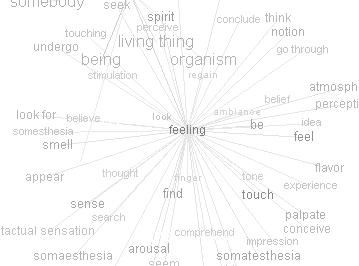
Plumb Design Visual Thesaurus

map of words
Several people have recommended the Plumb site in response to my post yesterday about visuals for the degrees of separation between words. This is a beautiful thing, but I now have this notion of conduit words, and would like to see all the ways of getting from say, sheep to soul. Or maybe the the top conduit words. Would they have a map? There would be so many ways to look at that data.

Letter writing

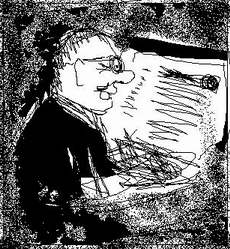
I see my journey in cyberspace as epistolary. The email is the return of the letter! It is an art. Are weblogs letters? In a way. The letter shown is from a site full of illustrated letters. I felt an affinity as I illustrate this weblog with pictures I like from the web. But I could make them! I’m inspired. Here is the commentary:

Painter John von Wicht (1888-1970) often personalized his letters with bold abstractions. In this note to his friend Will Barnet, von Wicht takes up a familiar topic among artists –the trade-off between teaching and painting. He also mentions his upcoming residency at Yaddo in Sarasota Springs, New York.

Web Pioneers

It is still hard for me to accept that the Net has a history. It feels like a very new thing. I am on it all the time, but I am still getting used to it. I still find it magical. It has gone very fast for me. I was here early by some standards, and had a sense of its potential, but then it passed me by somewhat. That “book” about Psyberspace is still a dream. Not a dead dream, mind you. The Wayback Machine (which I have linked to before) has a Web Pioneers feature. And yes, it all looks like the past. Pioneer websites.

What attracted me to the pioneer item was stumbling upon (not with the software agent, but by reading my zine linked earlier) an item we had on the old BBS by Bruce Stirling. This is pioneering work I enjoy, and it reads well now 11 years? later. Nice easy style. I think I’ll quote from it often.

Here’s the President of the United States speaking at a library in 1890.

“The boy who greedily devours the vicious tales of imaginary daring and blood-curdling adventure which in these days are far too accessible will have his brain filled with notions of life and standards of manliness which, if they do not make him a menace to peace and good order, will certainly not make him a useful member of society.” Grover Cleveland hit the nail on the head. I feel very strongly, I feel instinctively, I feel passionately that I am one of those nails. Not only did I start out in libraries as that greedy devouring boy, but thanks to mindwarping science fictional yellow-covered literature, I have become a menace to Grover Cleveland’s idea of peace and good order.

Far too accessible, eh Mr President? Too much access. By all means let’s not provide our electronic networks with too much access. That might get dangerous. The networks might rot people’s minds and corrupt their family values. They might create bad taste. Think this electrical network thing is a new problem? Think again. Listen to prominent litterateur James Russell Lowell speaking in 1885. “We diligently inform ourselves and cover the continent with speaking wires…. we are getting buried alive under this avalanche of earthly impertinences… we… are willing to become mere sponges saturated from the stagnant goosepond of village gossip.”

The stagnant goosepond of the global village. Marshall MacLuhan’s stagnant goosepond. Who are the geese in the stagnant pond? Whoever they are, I’m one of them. You’ll find me with the pulp magazines and the bloodcurdling comics and the yellow-covered works of imaginary daring. In the future you’ll find me, or my successors, in the electronic pulps. In the electronic zines, in the fanzines, in the digital genres, the digital underground. In whatever medium it is that really bugs Grover Cleveland. He can’t make up his mind whether I’m the scum from the gutter or the “cultural elite” — but in either case he doesn’t like me. He doesn’t like cyberpunks.

He doesn’t like cyberpunks. That’s not big news to you people I’m sure. But he’s not going to like cyberpunk librarians either. I hope you won’t deceive yourselves on that score.