Archive for the ‘psychotherapy’ Category

Online Therapy Catching On In Australia

Saturday, August 7th, 2010

Online Therapy Catching On In Australia | Gov Monitor:

Online therapy sessions could deliver help to thousands of Australians including women seeking help with domestic violence and country people whose self-reliance, heavy work schedule and geographic isolation rule out seeing a therapist face-to-face.

A review of technology use in therapy, counselling and dispute resolution by the Australian Institute of Family Studies has shown counselling in cyberspace holds “a great deal of promise”.

The Institute’s Elly Robinson says the increasing proliferation of online therapy sites offers an alternative source of help that may suit some clients with some types of problems.

“It’s astonishing that no more than a generation separates everyday users of computers, mobile phones and the internet from people for whom these tools are completely foreign,” Elly Robinson said.

“Yet there are signs that online therapy could be helpful for rural people, single parents at home, people dealing with issues of violence, or those who want anonymity and the privacy of accessing a service in the comfort of their own home,” she said.

Young people familiar with technology may be particularly suited to online therapy. However people over forty, more marginalised groups and the computer illiterate are less likely to be suited to online treatment.

On persistence & potency in psychotherapy.

Saturday, July 17th, 2010

A psychotherapy client or a couple may present with these dynamics:

I listen as he or she blames, blames and blames their spouse or partner. It all make sense. The pain is real and the partner does all those things they are accused of.

I invite the client into a dialogue with their partner (in couple work or as part of a role enactment using psychodramatic production one-to-one.)

“You push me away. You malign me. It’s not fair. You let me down. You are self absorbed. You are angry and you attack me. You are not capable of being civil. You are mad and crazy. You must be punishing me.”

I usualy intervene to stop such blaming before it reaches this level.

Here is what I see in my minds eye, and what I am thinking.

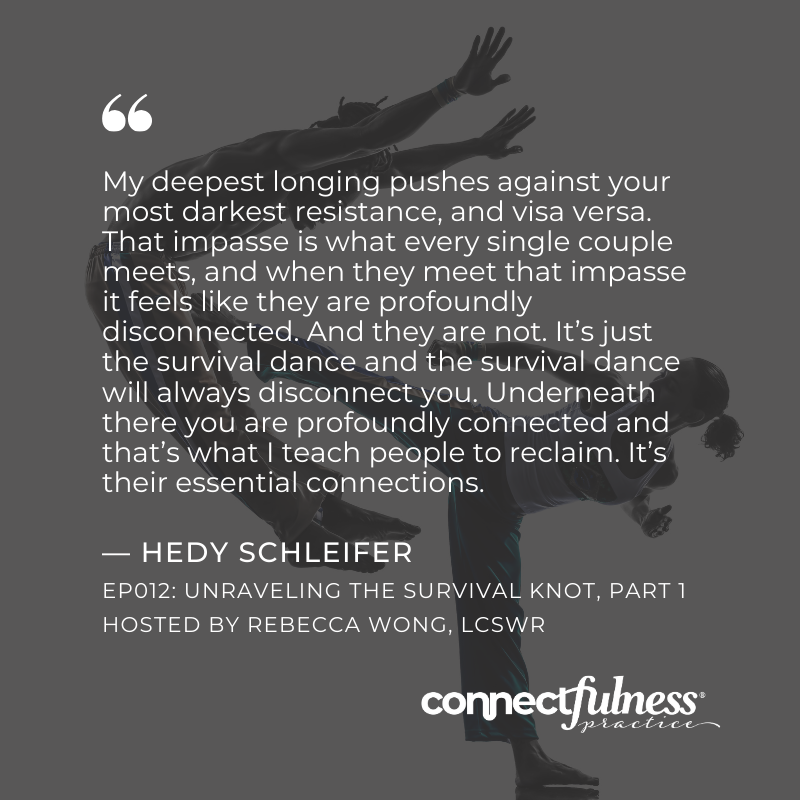
It’s a dance. There is no I or you. There is a co-created enactment of defences against…. not each other, but the pain that results from imperfections of the world when they were in their formative years, and also from the nastiness of all the pain of the world.

The anger is a warning system. It is a by product with the function of drawing attention to the root of the problem. I see sirens flashing and alarms screaming. Red lights. The alarms go completely unheaded. It is as if the meaning of alarms has not been explained. The madness in the system is that the response to alarm is alarm.

I can see the dynamics the alarms are called to alert us to, pain, uncertainty, helpless struggling babies.

I can imagine the vicious circle. When you fight I run. When you feel alone and rush at me, I fight. When I fight you blame. When you blame I run. And so the dance builds with ever increasing intensity.

Feelings, needs and healing possibilities are ignored as the anger builds with reactivity be it passivity or aggression.

I can already see the potential for healing in the dance when the first You is uttered. I see my client’s pain and see them owning it. I see them take responsibility for it. I see them imagine through the defences of their partner to the wounded child and I imagine them feeling empathy, and the urge to reach out, and then actin on that urge. I see a healing drama.

I see the possibility of my client asking and offering new behaviours that are congruent with their own needs and ability. I imagine a dance of giving and receiving:

“I will listen. I want to be held. When I feel scared I want you to be soft and light. When I have the urge to run I will stop and be still. I want you to say you appreciate my work in the house. I want you to initiate love making. I will go on a run each night so my sleeping pattern might be better for our relationship. When I have the urge to blame I will request a time to talk and listen.”

These are my thoughts in the first few seconds of blaming.

The client has no inkling of what is possible. They are an alarm that is screaming. In the session perhaps for first time ever there is no alarm being triggered in response. (Either I am the listener, or I insist the couple takes turns to listen.)

They are in a raw state. The fury turns to calm.

~

This is by way of introduction to the main is that prompted me to write, that the image I see of healing in those first few seconds will take months to realise and during that time I have hope but they might not. There is a lot of trust I need to hold in this work while the clients may simply not have it, not have the experiences to base any trust on. No matter how much work we do to keep the therapeutic space “safe” it is not experienced as safe because the long held defence habits are removed and the rawness of old pain comes to the surface. Often as that pain is met with loving attention deeper wounds are revealed.

I am reminded of the three Ps in TA, Permission, Protection = Potency. For some reason I thought persistence was in there too! I need to hold on to my ability to manage a process that might well look like a ten car pile up on the motorway. How client centered is it when all they want to do is fight and blame and I work towards something different?

Scripts- the Role of Permission – by James Allen and Barbara Allen:

# Permission to exist.

# Permission to experience one’s own sensations, to think one’s own thoughts, and to feel one’s own feelings, as opposed to what others may believe one should think or feel.

# Permission to be one’s self as an individual of appropriate age and sex, with potential for growth and development. # Permission to be emotionally close to others.

# Permission to be aware of one’s own basic existential position.

# Permission to change this existential position.

# Permission to succeed in sex and in work; that is, to be able to validate one’s own sexuality and the sexuality of others, and to “make it.”

 # Permission to find life meaningful.

4 Psychological Defenses

Wednesday, July 14th, 2010
  • fight
  • flight
  • freeze
  • please

There is no such thing as a person

Saturday, July 3rd, 2010

Winnicott famously said “there is no such thing as a baby.” (reference?) meaning of course there was always a baby and someone. Jacob Moreno’s notion of a social and cultural atom (reference?) is similar and more startling. There is a minimum set of roles (interactions) that need to be present for survival. In other words there is no such thing as a mother either, there is always a mother and a father (absent or not). The reference to role systems and dynamics is important here. We are not talking about people but relationships and ways of relating. People who don’t do anything are dead. Primacy of the relationship is not an uncommon idea in psychotherapy, even when the word ‘object’ is used in some schools of therapy, it is the ‘object relations’ that are important. For all that it is a big mind-shift to go from the every-day world of things and entities into the psychological world of dynamics.

The physical body, physical reality, so easily belies psychologically potent reality. Psychodrama has the power to reveal all the subtle bodies usually invisible, the use of the term surplus reality facilitates this. But even in psychodrama the mind-shift can be hard to make. Imagine a group of people, with their bodies invisible, see them as three dimensional movie programs of archetypal dramas, developmental processes and graphical depictions of experience of ecstasy & trauma in the cellular memory. The current state of warm-up is the movie that is playing right now. At any moment other movies could grab the screen, all the programs are networked. The body does not betray the soul, but it can fool us into thinking there is no soul. No wonder we have the idea of the eternal soul, it is collective, unconscious and interconnected back to the big bang.

The implications for psychotherapy are well known but difficult to fully implement. One potent central idea, is that the therapeutic relationship is the source of healing. Even that one, well established and standard in most definitions of psychotherapy is always under threat by talk of dependency, measurable evidence, behaviour, genes, chemicals, brains. And of course the demand for reports and videos introduce more elements into the relationship. The third eye kills the diad and creates a group. This may not be a bad thing if it were consciously embraced. If we said there is no such thing as a diad, however it often advocated that the third presence should be ignored. “After a while we forget there is a video camera in the room.” Denial of surplus reality. In the face of all these onslaughts psychotherapy has survived, and the healing power of relationship is constantly experienced and valued.

More important is the idea of social atom repair. In therapy all too often people warm-up to working on the relationship with the mother, and then later the father. As a psychodramatist I work, even in one-to-one settings with the idea of repairing the social atom. Whatever the medical mental health diagnosis people come with relationship difficulties. DSM style diagnosis are always blind to the psychological as they are totally fooled by and perpetuates the idea individual people. Those difficulties are present in the parental diad in some form. An investigation of the role system in the parental diad often sheds light on the current relationships. The most successful work I have done is where the “parents” enacted by the client, come to relationship psychotherapy. The client then, in the regressed state of the child, experiences their renewed parents. A new social and cultural atom is available to them.

This is similar to the TA idea or “re-parenting the parent”, but taken to a relational level.

Couple therapy, working directly with a relationship follows from the fundamental idea of a dynamic psyche. Yet therapists often talk of individual work as needed for a healthy relationship. Harville Hendrix’s Imago therapy, and Moreno and psychodrama before it, as well as all forms of family therapy with a systemic approach are more in tune with the psychological reality. In making the ‘imago’, the unconscious images operating in the relationship, the unit of therapy is a major breakthrough in psychotherapy. Hendrix’s phrase “The purpose of marriage is to heal childhood wounds.” (reference?) is profound. If we in the psychotherapy field embraced this we would use the healing potential in the couple relationship rather than the therapeutic relationship for psychological repair far more than we do.
There are time when couple work is not indicated, apart from when people are not in a couple. When attachment wounding is so strong that taking turns with each other and with a therapist is unbearable and leads to disruptive behaviour, I think it is rare.

People are myth. What is significant is ‘surplus’ to the physical entities, it is imaginal and systemic.

~~~
(Below is a quote that I found of interest, though a bit peripheral to my main points)
Perspectives – Vol. 6, No. 1 – A Primer on Narcissism – Page 3 of 3:

The first to seriously consider the similarity between Narcissistic and Schizoid pathologies was Melanie Klein. She broke with Freud in that she believed that we are born with a fragile, easily fragmentable, weak and unintegrated ego. The most primordial human fear is the fear of disintegration (death), according to Klein. Thus, the infant is forced to employ primitive defence mechanisms such as splitting, projection and introjection to cope with this fear (actually, with the result of aggression generated by the ego). The ego splits and projects this part (death, disintegration, aggression). It does the same with the life-related, constructive, integrative part of itself. The result of all these dynamics is to view the world as either “good” (satisfying, complying, responding, gratifying) – or bad (frustrating). Klein called it the good and the bad “breasts”. The child then proceeds to introject (internalize and assimilate) the good object while keeping out (=defending against) the bad objects. The good object becomes the nucleus of the forming ego. The bad object is felt as fragmented. But it is not gone, it is there.

Role of the Therapist with Couples

Saturday, June 19th, 2010

There is a continuum with two extremes.

Its all in the dialogue between the couple ____________________________________ Its all in the safety of the relationship with the therapist

Of course it is both, I doubt anyone holds the extreme positions. However it is an interesting question as to when one of these aspects needs to be to the fore.

This discussion with Rick & Sherry Stolp addresses this question very well, among other things.

Click to play & downloadListen or download here

Rick Stolp website


David Grove’s – Emergent Knowledge

Monday, May 17th, 2010

Emergent Knowledge – David Grove’s ‘clean’ facilitation and communications methodology, six degrees to freedom, plus and introduction guide for learning

http://www.businessballs.com/emergent-knowledge.htm

THE ETHICS OF DUAL RELATIONSHIPS by Karl Tomm

Sunday, May 2nd, 2010

I found this interesting about 20 years ago when I first read it. Might be worth a review.

THE ETHICS OF DUAL RELATIONSHIPS
by Karl Tomm

First paragraph follows/

Click to continue reading “THE ETHICS OF DUAL RELATIONSHIPS by Karl Tomm”

Lunig MP3 from nelson NZAP conference

Saturday, April 24th, 2010

Conference Nelson 2010:

In The Unknown Date: 18-21 March 2010 Hosted by: Te Tau Ihu o Te Waka a Maui (Nelson/Marlborough/Bays)

Podcasts of Key Note addresses: (Thanks to Julian Wilson, Auckland) Jonathan Fay’s Key note address:

Jonathan Fay.mp3

Michael Leunig’s Key note address:

Michael Leunig.mp3

Right Click on links to  download of MP3 files that can be played with Windows media player or Itunes.

Manufacturing Depression

Saturday, March 6th, 2010

Democracy Now! 1 March 2010

There are several stories in this hour long program, one about earthquakes, one about race in a Californian university, and one about depression. The last one tells me what I know as a psychotherapy to be true. Not that antidepressants don’t always work, but that why they work is a big muddle, it could be the placebo effect or just time. And the price for this dubious result is to pathologise millions of people, to get them thinking about the psyche in a medical & unhelpful way.

All for huge profit.

The DSM 5 is a scandal and will make the problem worse!

All part of a 150 year trend… that bit was new to me.

Video of the Depression story on Democracy Now

Every health professional should watch this video, listen to this last story in this episode of Democracy Now, or read the book by Gary Greenberg, Amazon:

Manufacturing Depression: The Secret History of a Modern Disease

Manufacturing Depression?:

The primary point that Greenberg expressed in the interview is that we are taking a normal human experience and turning it into a disease. He makes it clear that he has no problem with relieving the suffering of depression with drugs, but he questions whether we have turned normal blue moods into a disease in order to justify medicating away sadness.

A satisfying read online is where Greenberg is interviewed on the Well. Quote follows.

Click to continue reading “Manufacturing Depression”

Identity & boundaries

Sunday, February 28th, 2010