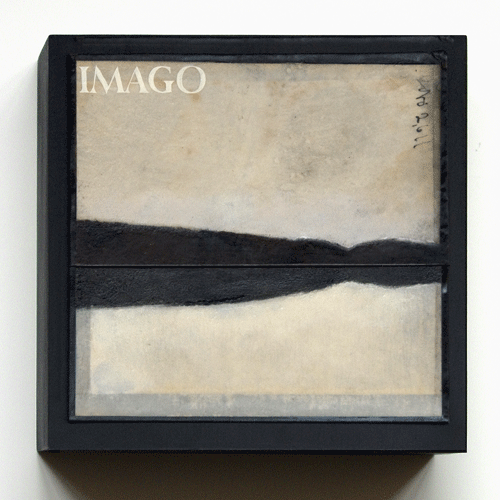
I like these images, I like the idea of using old books.
I like beeswax.
And it is here because of the Imago word. But I will put this whole post on my http://www.walterlogeman.com/art blog
Notes from her website follow

Walter Logeman: Journal
I like these images, I like the idea of using old books.
I like beeswax.
And it is here because of the Imago word. But I will put this whole post on my http://www.walterlogeman.com/art blog
Notes from her website follow
I like these images, I like the idea of using old books.
I like beeswax.
I want to make prins that have something of this feel.
I will put this whole post on my psyberspace blog because it has the Imago word, an in depth approach to the co-unconscious in relationships.
These assemblages are made
made from the covers of used
books. I seek out those that
bring their own history –
inscriptions, notations, signs
signs of wear and amateur
mending – poignant glimpses
into the previous owners’ lives.
When dipped into melted
beeswax, the papers become
translucent, and unexpected
details emerge. Sometimes
the paper on the inside covers
tear in a way that suggests
landscape, and I add to these
readymade images, painting
the moon in various phases
and hand-lettering appropriate
words from a Latin dictionary.
On some, I add tiny diamonds,
to suggest stars or lights.
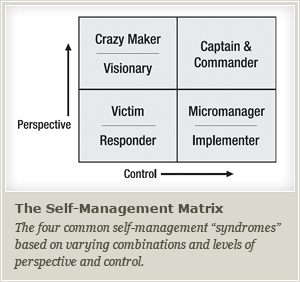
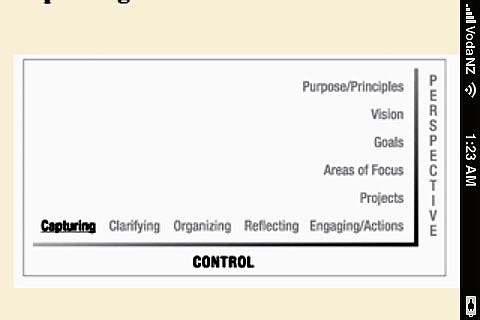
I downloaded the ebook to my phone. I’d seen a few poor reviews mainly saying it was a re-hash. It is in some ways but the simplification of the steps into two groups: Control steps & Perspective steps is elegant! Worth the price of the book IMO.
The Matrix diagram is useful, but the next one covering the 11 steps is the essence of simplicity.
As I read the book I am slightly tweaking my system as I go. It is beginning to work well for me. After several years of GTDing I have almost got a system I trust! Shifting from Palm amd the PC to iPhone has made a big difference.
David Allen suggests that there is a qualitative leap when the mind is truly freed of having to do the tasks the *systems* should do. I’m getting close.
Buy on Amazon

A portrait of ARIA award-winning blind musician Geoffrey Gurrumul Yunupingu has won this year’s Archibald Prize.
Guy Maestri’s close-up of Yunupingu’s face was the bookies’ favourite ahead of today’s announcement at the Art Gallery of New South Wales.

Whakapapa
Kahukiwa began painting as a young housewife in Greymouth in the late 1960s. A belief in whakapapa underpins her work: ‘My identity in things Maori is made possible because of my ancestors. It exists because of whakapapa, tribal culture and tradition. My links with the past are as important to me as the fact of my being, my future and the future of my children.’
Te Papa holds eighteen works by Robyn Kahukiwa.


I continue to hold an hypothesis that the behaviour of particles is a microcosm of human relationships. Not just as a metaphor, but that something of the “tele” involved is the same in both levels.
Listening to this podcast from Nights on RNZ confirms and extends this hypothesis. But hypothesis aside – it is ASTOUNDING stuff!
Synchronistically I just had this one arrive from the BBC IOT, have not listened yet.
On the back burner I have a study / paper I want to do: Varieties of Encounter, today I was delighted to read a snippet from Elizabeth Synnot’s Thesis. The delight is there too because I want to bring forth dialogue, encounter in the training for the CITP
A SOCIODRAMATIST AT WORK
Producing Genuine and Reciprocal Relating
to
Create a Leadership Renaissance
September 2005
A quote follows from her thesis available on the ANZPA site
I’m motivated about theatre after todays experience is Second Life, both because of it being a Theatre par excellence AND because our host Kim had such an exciting deep perspective about drama and education. Learning about Boal was a find, though it is more a case of finding something lost. I think I owned a copy of Theatre of the Oppressed at one time, having a brush with Paulo Friere in the early seventies. He spoke here just as we were setting up a school.
The motivation is not just an external thing, it has been on my mind as I prepare to train others in Psychodrama this year. Theatre is an essential component of Psychodrama – it is as much theatre as therapy, it is therapy because it is theatre… but we must go further than that. Psychodrama is not only “clinical Psychodrama” it includes applications on the world, good theatre can transform the world.
I don’t like the line he has below, though the last thing I really want is a debate, I love the spirit of all this,
“it is a rehearsal for the revolution”
The reason I don’t like that in therapy is more obvious. It is possible in surplus reality to scream, shout, and annihilate whole planets, to do what you will. This only works if people are stable enough to see this as NOT a rehearsal.
So what is it?
Transformation, making things possible in the world.
So, when it comes to Sociodrama, that too might be a way of transformation, making things possible in the world.
Theatre guru Augusto Boal: “As workshop leader, I am merely an instrument”
February 2008 –“I always fiercely opposed our government, but that is over now. Gilberto Gil is an excellent Minister of Culture. The Minister of Justice recently announced that cultural centres will be established in two hundred Brazilian cities. That is fantastic, because I know this is not an empty promise. It feels like a reward for our years of work.”
Augusto Boal
Augusto Boal (Rio de Janeiro, 1931) wrote his first book, Teatro del oprimido (Theatre of the Oppressed), in 1975. His philosophy has attracted followers under that name throughout the world. “The audience holds a general rehearsal for what happens in daily life. Key concepts are human development and freedom. The theatre shows us new roles. In essence, these roles are ready and waiting for the time when the viewer actually needs them. The theatre itself is not revolutionary: it is a rehearsal for the revolution.”
I had my first Second Life Experience today. It was OK!
I have written it up in a private space.
I am excited to learn about Augstus Boal and Metaxis
Blog post quote follows
