Chapter from Psychodrama Since Moreno – Amazon
[pdf-embedder url=”https://psyberspace.walterlogeman.com/files/2012/Psychodramatic-moral-philosophy-ethics-JonathanDMoreno.pdf” title=”Psychodramatic moral philosophy and ethics – Jonathan D Moreno”]

Walter Logeman: Journal
Chapter from Psychodrama Since Moreno – Amazon
[pdf-embedder url=”https://psyberspace.walterlogeman.com/files/2012/Psychodramatic-moral-philosophy-ethics-JonathanDMoreno.pdf” title=”Psychodramatic moral philosophy and ethics – Jonathan D Moreno”]
Here is a quote from Moreno that has major implications for how we conduct psychodrama in groups or with individuals when they want to work on significant relationships and the other party is not present. Can we trust their representation?
Can a person in a couple relationship role reverse with their partner?
In a group can someone do a drama involving an intimate other who is not there?
These are questions I will be exploring in action with colleagues. in a workshop at the AANZPA conference in Brisbane in January.
Marriage and family therapy for instance, has to be so conducted that the “interpsyche” of the entire group is re-enacted so that all their tele-relations, their co-conscious and co-unconscious states are brought to life. Co-conscious and co-unconscious states are by definition such states which the partners have experienced and produced jointly and which can therefore be only jointly reproduced or re-enacted. A co-conscious or a co-unconscious state can not be the property of one individual only. It is always a common property and cannot be reproduced but by a combined effort. If a re-enactment of such co-conscious or co-unconscious state is desired or necessary, that re-enactment has to take place with the help of all partners involved in the episode. The logical method of such re-enactment a deux is psychodrama. However great a genius of perception one partner of the ensemble might have, he or she can not produce that episode alone because they have in common their co-conscious and co-unconscious states which are the matrix from which they drew their inspiration and knowledge.
Psychodrama Volume 1, 4th edition, page vii
In short…
Couple and family therapy has to be so conducted that the “interpsyche” of the entire group is re-enacted so that all their tele-relations, their co-conscious and co-unconscious states are brought to life. Thus the interpsyche involves states which the partners produced jointly and which can therefore be only jointly reproduced, by a combined effort. The logical method to re-enact an episode in the life of a couple is psychodrama. However great a genius of perception one partner may be, he or she can not produce that episode alone because they have in common their co-conscious and co-unconscious states which are the matrix from which they draw their inspiration and knowledge.
The logical method of such re-enactment a deux is psychodrama.
Later — Friday, 22 December, 2017
Just noticed this quote fro Marshall Rosenberg:
It may be most difficult to empathize with those we are closest to.
Moreno was not alone in noticing this phenomena
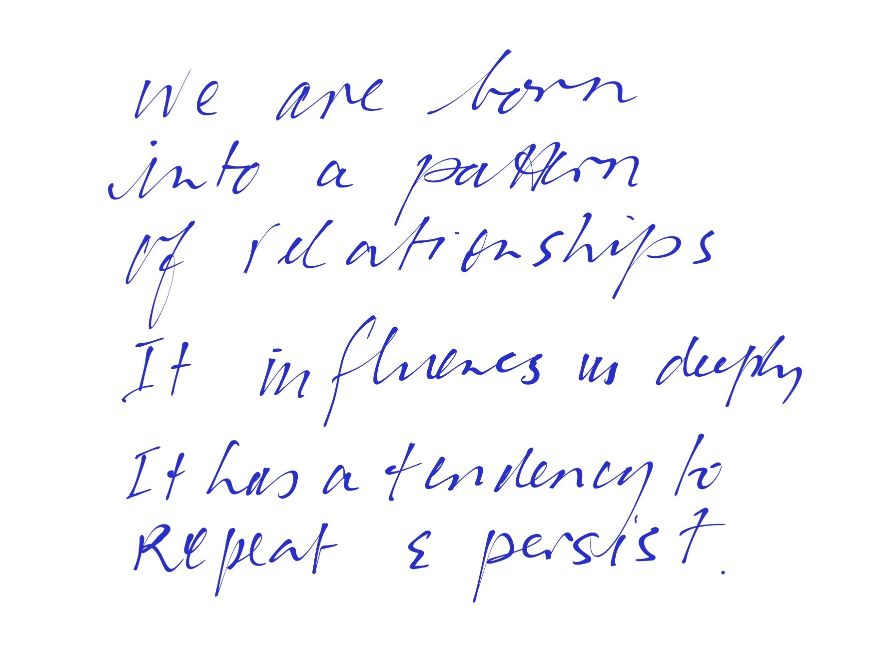
This is my summary of what Moreno means by the social atom. In psychotherapy that “atom” or pattern is the client. When two of these “patterns” connect in love, then a lifelong process can follow. Maybe it is true love at first sight? Unlikely, love is blind. One possibility is to move from blind love to deep mature connection. The other possibility is hell. A third is lifeless boredom.
Psychodrama is a form of therapy. Jacob Levi Moreno founded the the early forms of the philosophy and practice in Vienna early in the last century. On page one of his seminal book: “Who Shall Survive?” he wrote about a therapeutic procedure.

Clearly a therapeutic procedure that has as its objective the whole of humankind stands out as a special case of psychotherapy. Psychodrama is a special case…
Continue reading “What is Psychodrama?”
I’m delighted to have plans and dates for a bunch of psychodrama events next year. I hope you will find something of interest!
Fri, 13 – Sun, 15 April
Fri, 31 August – Sun, 2 September
Experience psychodrama for your personal development!
Download flyer and enrolment details
Writing Retreat Mt Lyford – for Psychodrama Trainees
Fri, 25 – Sun 27 May
Writing is an essential part of psychodrama training.
Download flyer Enrol: http://psychodrama.org.nz/citp-2018c
Working With Couples – Professional Development – Christchurch
Christchurch Fri, 6 – Sun, 8 July 2018
This workshop will enrich your work with couples. Also a good way to get started.
Just announced a Psychodrama Weekend. I have conducted many psychodrama weekends and I’m pleased to have warmed up to something new for this one.
Pace Layers Thinking: Paul Saffo and Stewart Brand @ The Interval — January 27, 02015
Wonderful podcast. Great exposition of an idea that came through looking at houses and then could be generalised.
The thinking applies to design as well as social change.
The image gives the idea:

~~~
I think of other theories of change:

Needs more explaining but has broad application W = warm-up
~~~
And then there is Dialectics. Not to be dismissed. Hegelian and then Marxist.
http://inthemessy.com/tag/advent/
“We cannot live for ourselves alone. Our lives are connected by a thousand invisible threads, and along these sympathetic fibers, our actions run as causes and return to us as results.”
The space between is invisible – we can only talk about it in metaphor e.g. “broken heart”, “bound together”, “muddy path” and here as “sympathetic fibers”. Not only do we use metaphor, we can use images and symbold – rings, hearts. And in psychodrama we have the simple act of concretisation: place people or objects at a distance to show where they are in your life. Distance becomes visible and conveys meaning.
The quote above from https://www.goodreads.com/author/show/3500800.Henry_Melvill (not the Moby Dick man) seems to be saying that our actions can live after us and multiply. Then come back as karma. And then impact everyone. Be careful what you say and do it can reverberate into the future.
I think of this as Moreno’s sociometric matrix. Sympathetic is a nice word there with its roots in symphony – all the parts of the network working together.
The network of course is a physical metaphor for something unseen, the space.
__________________________________________________
Background
http://melvilliana.blogspot.co.nz/2011/09/finest-thing-herman-melville-never-said.html

__________________________________________________
Lenin used the concept often
https://www.marxists.org/archive/lenin/works/1917/7thconf/24c.htm
All humanity is thrown into a tangled bloody heap from which no nation can extricate itself on its own. Though there are more and less advanced countries, this war has bound them all together by so many threads that escape from this tangle for any single country acting on its own is inconceivable.
The_Social_Constructivist_Movement_in_Modern_Psych
Kenneth J. Gergen 1985
To Read.
Question: Do they really think there is no individual?
I thought it was radical to say that the relationship has the individuals rather than individuals have a relationship. That still means there are individuals.
Must read it.
This is an interesting and valuable paper and link to kindred spirits. Something to integrate into my long paper on methodology.
http://www.leeds.ac.uk/educol/documents/00001388.htm
Community-Based Research: Creating Evidence-Based Practice for Health and Social Change
Marcia Hills, R.N., Ph.D.
Jennifer Mullett, Ph.D.
Community Health Promotion Coalition
University of Victoria
Victoria, BC, CanadaPaper presented at the Qualitative Evidence-based Practice Conference, Coventry University, May 15-17 2000.
Evidence-based practice usually refers to gathering quantitative data upon which to base decisions about what constitutes effective or efficient practice or what is sometimes referred to as “best practices”. The authors argue that, when gathering evidence about practice concerning people in communities which is often the case in the health sector, different evidence is needed and, consequently, different methodologies and methods for collecting that evidence must be used. In this context, the notion of basing practice on evidence raises the question “what do we accept as evidence upon which to base our practices that involve people in communities?”