I listened to the audio book of Naomi Klein’s Shock Doctrine last year & . With Haiti disaster I thought, right they’ll be in boots and all – no need to use the military, let nature do the killing for you. And sure enough, it seems the US is doing its best take over (even more) while the going is good. Some links follow.
My Tweets 2010-01-18
A few from my Sydney trip… links to pix.
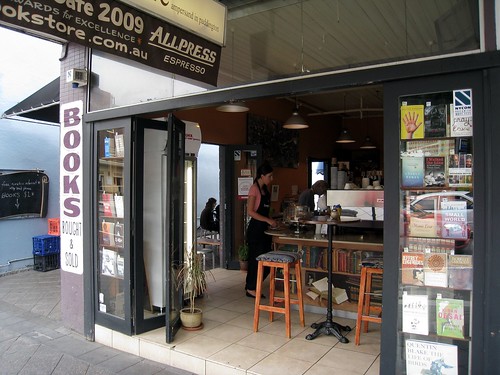
Ampersand Bookshop Paddington
Ampersand Bookshop Paddington, originally uploaded by Waltzzz.
Had a good time here today! Worth coming to Sydney for.
iWishlist
I am looking forward to the Apple Tablet. The main thing I’d want to be able to do is to use it instead of my Toshiba M200 for sketching. I did a Thousand Sketches 2006-7 on the Toshiba M200 which has a Wacom style pen only touch screen. Worked well for me. It is pressure sensitive, and highly responsive. So I hope the Tablet will have something like a pen or better.
A long iWishlist follows.
Chagall
Book: The Invisible Century: Einstein, Freud, and the Search for Hidden Universes by Richard Panek
I leafed through this book today. I like the theme, but I think the analogy of a story with two protagonists is taken a bit far. Still, looks like it could be fun. Might get it yet!
Some reviews follow.
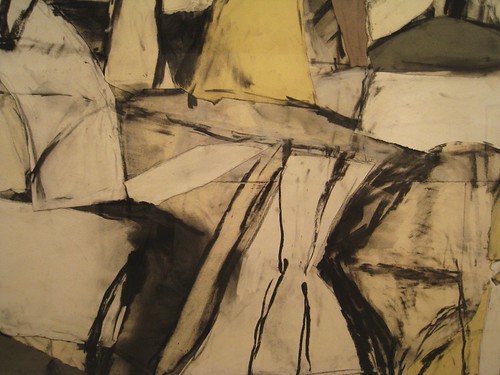
Sydney Experience – Art Gallery
Having a great time in Sydney. Gallery yesterday. The above is one of quite a few from the Gallery of NSW posted into a set on Flickr.
Progress and Pitfalls in Sociometric Theory
I’ve tagged this “psychodrama-lib” I think we have this journal in the Christchurch Psychodrama Library, and it looks like a good article. I am particularly interested in the idea that there is a different reality in the group, “underlying, intangible, invisible,unofficial structure but one which is more alive, real and dynamic than the other.” to quote from the first page, all they will give me on the Net!!
JSTOR: Sociometry, Vol. 10, No. 3 (Aug., 1947), pp. 268-272:
# Progress and Pitfalls in Sociometric Theory # J. L. Moreno # Sociometry, Vol. 10, No. 3 (Aug., 1947), pp. 268-272 (article consists of 5 pages) # Published by: American Sociological Association # Stable URL: http://www.jstor.org/stable/2785077
Mnajdra
Plan Of The Temple Complex At Mnajdra.
Article by Bernadette Flynn who is doing research on this site, but more specifically research into knowing. The reconstruction of ancient ruins is the basis to explore an approach to knowing through the body. Embodiment. All this reminds me of the ways of know I’ve been researching. Theatre, dance, phronesis.
Flynn-final – Powered by Google Docs:
The principle purpose of this paper is to investigate how simulation spaces in cultural heritage can incorporate somatic knowledge i. An understanding of the past that starts with the somatics of the sensing, feeling mobile body is a radical departure from traditional approaches to digital cultural heritage where the corporeal dimension has been absent. To date simulations of cultural heritage have largely focused on processual archaeological accounts of the past to inform design practice. This has resulted in an emphasis on mathematically accurate representations of the past. While these accurate representations simulate material culture to a high degree of technical sophistication they fail to take account of the sensing body and thereby de-emphasise significance aspects of end user engagement.
This paper seeks to address this imbalance by investigating the application of somatic knowledge to the creation of an interpretative digital cultural heritage space. Using the framework of interpretative archaeology consideration is given to phenomenologicaly informed accounts of prehistory that focus on embodied experience of the built environment. This paper identifies approaches in the work of pheneomenological archaeology that can usefuly interpret the spatiotemporal characteristics of an archaeological site in relation
to living moving bodies. Broader discussions of embodiment are framed from the perspective of the cultural heritage visitor as end user. The paper considers users subjectivity as in dialogue with the spatial aesthetics of the landscape morphology, and outlines how interaction design can be mobilized to explore an embodied encounter with architectural remains
Book: Masons, Tricksters and Cartographers
Science and technology have created many of the problems besetting us at the turn of the century, yet, paradoxically, we cannot address them without their assistance. This beautifully illustrated book takes a fresh approach to resolving the problems of progress and modernity by reframing science and technology. In an eclectic and highly original study, Turnbull brings together a wide range of traditions as diverse as cathedral building, Micronesian navigation, cartography and turbulence research. He argues that all our differing ways of producing knowledge, including science, are messy, spatial and local. Every culture has its own ways of assembling local knowledge, thereby creating space through the linking of people, practices and places. The spaces we inhabit and assemblages we work with are not as homogeneous and coherent as our modernist perspectives have led us to believe-rather they are complex and heterogeneous motleys.