More

Hollywood and Baudrillard

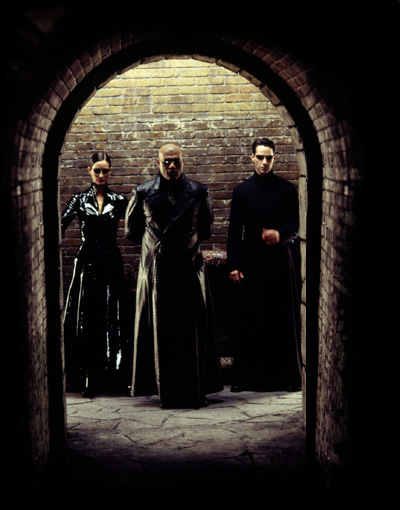
The Matrix and Baudrillard’s Concept of Simulation

Evil Demons, Saviors, and Simulacra in The Matrix

by Doug Mann & Heidi Hochenedel. This essay is well done. Looks at the themes as three distinct entities: Christian, Descartian, and Baudrillardian. Convincing, apart from its conclusion, which may be because of the bankruptsy of The Matrix themes themselves, after all the movie is itself part of the hyperreal Hollywood machine. Or it may be that they have some strange pomo ideology?

I went to the hyper website and used copy, paste-into-editor, print, to get an accademic looking paper from the unreadable mess (including irritating sound!) on the screen. This process was like returning to a welcome desert of the real – I like it better in black and white.

Open Knowledge – great idea.

MIT OpenCourseWare | Home

MIT and the OpenCourseWare team are excited to share with you a first sampling of course materials from MIT’s Faculty. We invite educators around the world to draw upon the materials for their own curricula, and we encourage all learners to use the materials for self-study.

This has to be phenomenal. Whatever their motives, whatever the actual use of it by the masses, somewhere somehow this can tip the balance… though of course for sheer access to knowledge the Internet has already made this transformation in the world.

I wonder what restrictions apply? What if I offer a course based on the material? What if other Unis do that?

See also the Wired item: All the World’s an MIT Campus

More fictional therapy.

I am reading Pilgrim by Timothy Findley. From the blurb:

For Jung, this man becomes an embodiment of the psyche’s mystery. Claiming to have no past history but to have simply arrived one day at consciousness, Pilgrim lives in a limbo outside individuality and subjectivity. He’s everyone and no one. Is he a messenger? Or is he a basket case? As the novel gathers momentum, we realize that Pilgrim is a character much like Virginia Woolf’s Orlando, traversing gender and time, a witness. But whereas Woolf is a feverish and emotional writer, Findley is philosophical and dry, playful and slightly pretentious. Imagining conversations between Pilgrim and Henry James, Leonardo da Vinci, and Oscar Wilde, this novel is like a party full of beautiful guests.