
at klondyke corner
by the waimakariri
a slither of new moon
above the main divide
takes my breath
awakens a cry
iPad Sketch event in San Francisco June 2011
Its a long time ago but I thought it was a great little event at the San Francisco Apple store.
Came away with links to two artists I particularly enjoyed.
Julia Kay who has a portraitparty on flkr
Helene Goldberg .

Family Video art
And more, these are funny!
The Group and its Protagonist – Archetypes of Cyberspace
I completed this psychodrama thesis in 1999 after working on it one way and another since about 1984. One feature of this paper is the discussion about the sociometric matrix, a notion that influences my ideas about cyberspace as well and were at the root of another essay I wrote – Archetypes of Cyberspace
I stumbled across this better pdf version of the The Group and its Protagonist – linked to it on my Writing page.
I’m wonering if there is some way to publish something based on these papers?
Occupy London
From Lenin’s Tomb
Readable & interesting report & comment here on Occupy London. While it may be a “punctuating moment” iI seems a very important one as the whole theme of this is like no other demonstrations I have seen, it is against capitalism, like the ones at the global summits, but this time there is no global summit, it global capitalism full stop. The slogan of the 99% is also very unifying, and makes a potent point.

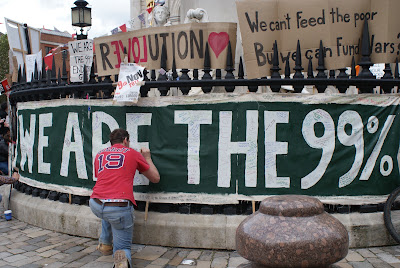
This isn’t a revolutionary situation, but merely a punctuating moment in the temporal flow of class struggle. But the purpose of slogans mentioning ‘Tahrir Square’ is to accentuate the internationalism of the movement, to point to its deep systemic roots, to express solidarity with the Arab Spring, to hope that this is the beginning of our own Spring, and to identify the commune as the political form of these aspirations. At the most prosaic level, it expresses the movement against austerity in its most ‘political’ moment, complementing the ‘economic corporatist’ moment of trade union struggle. It identifies the political class rule of the 1% as the key problem; the colonization of the representative state by big capital. And it proposes its own direct democratic answer.
The psychodrama technique of the mirror
Quotes from Moren follow:
Exaptation – copy & paste in the evolution of tech and culture
Just got a name for something I have grasped for a long time. I used to call it accidental by products of evolution, and had this idea when I was doing biology aged 15. EG the piano is a by product of the evolution of fingers. We as humans have gone beyond what was biologically fittest, accidental by-products just heaped upon themselves and interacted with each other to enable creativity and consciousness.
From What Technology wants by Kevin Kelly page 50: “These inadvertent anticipatory inventions are called exaptations in biology.”
“Exaptation is a term used in evolutionary biology to describe a trait that has been co-opted for a use other than the one for which natural selection has built it.”
“It is a relatively new term, proposed by Stephen Jay Gould and Elisabeth Vrba in 1982 to make the point that a trait’s current use does not necessarily explain its historical origin. They proposed exaptation as a counterpart to the concept of adaptation.
For example, the earliest feathers belonged to dinosaurs not capable of flight. So, they must have first evolved for something else. Researchers have speculated early feathers may have been used for attracting mates or keeping warm. But later on, feathers became essential for modern birds’ flight.
It is a relatively new term, proposed by Stephen Jay Gould and Elisabeth Vrba in 1982 to make the point that a trait’s current use does not necessarily explain its historical origin. They proposed exaptation as a counterpart to the concept of adaptation.
For example, the earliest feathers belonged to dinosaurs not capable of flight. So, they must have first evolved for something else. Researchers have speculated early feathers may have been used for attracting mates or keeping warm. But later on, feathers became essential for modern birds’ flight.
(Perry, 2013)
In the evolution of technology and culture it is all exaptation. The reason is that the basis of tech and cultural evolution are not genetic, the information is carried by social means. Thus nothing goes extinct, and all innovations can be resurrected. In other words we can cut and paste to make new things, that process is far faster and more efficient than evolution in the biological sphere. Sexual reproduction is a form of cut & paste, but still far more primitive than what we can do with our inventions.
For example: Id love to graft the Graffiti handwriting system from the dead Palm onto a current smartphone.
References
Parry, Wynne. (2013, September 16). Exaptation: How evolution uses what’s available. Retrieved February 8, 2016, from http://www.livescience.com/39688-exaptation.html
Don’t live life in the sewer of injustice
Wallace Shawn (My diner with Andre) at occupy Wall Street
Moreno’s concept of tele
A series of quotes follow
Social and cultural atoms – Interact
The pattern of role relations around an individual as their focus is called his cultural atom. Every individual, just as he has a set of friends and a set of enemies, – a social atom – also has a range of roles facing a range of counter-roles.
Psychodrama v. 1 p. 84
~
I am reflecting on how the “imago match” relates to role theory.
The interpsyche occurs then when the role cluster of a couple is particularly intertwined. Love. Upon investigation I imagine there would be a particular quality to the role relationships. The tele would be strong at least in some areas. In the interpsyche the roles in a current relationship are likely to match the roles and social atom of the family of origin. The tele with the roles matched to the original social atom of each party would be strong. The mutual and positive/negative matches would outweigh the neutral?
This is a psychodramatic look at what Harville Hendrix calls the “Imago”. Sociometrically it can be explored in great depth. In couple therapy we are looking at role relationships. The assessment is a sociometric role analysis.
It would be good to explore this on the stage as part of the role assessment, working with a couple or in a sociodrama or in supervision of couple therapy.
~
More moreno quotes follow on the cultural atom