Jottings

I’ve updated my writing page and moved it to https://www.walterlogeman.com/writing

Reflecting on my work – some of it going back to 1993.

I’m not so obsessed with the internet as I was in the 1990s. I still think the psyche is created through various creative acts such as naming, writing theorising and managing the medium. The psyche evolves. I’d be happy to call it culture, zeitgeist. I think this  creativity goes beyond cyberspace. Marx created a bunch of concepts that fit. We can invent fiction and we also invent non-fiction but it has to relate to the real, to fit, to resonate. to enable.

I learned about hyperstition today

Podcast Youtube 

The K-Files: Who’s Pulling Your Strings? featuring Amy Ireland

(I will watch this https://vimeo.com/ondemand/hyperstition/167803565)

Truth is Science is Fiction.
HYPERSTITION
a film by Christopher Roth
in collaboration with Armen Avanessian

More here:

https://www.full-stop.net/2020/10/21/features/essays/macon-holt/hyperstitional-theory-fiction.

Archetypes

Hermes rules the internet – he pulls the strings – but he can’t pull them all — but no one can.

And who rules the world? Mammon?

Who is the angel of history?

https://www.wikiwand.com/en/Angelus_Novus

It’s like naming a theme in a group. I concretised a discussion by drawing a line on the stage. A fine line between moaning and denial. It resonated.

Does the Angelus Novus resonate with some sort of reality?

Is “relations of production” an angel? who is that entity pulling the strings?

The meaning of INTERSTITIAL is occurring in or being an interval or intervening space or segment : of, relating to, or forming an interstice.

interstition
An interstice or interstitium; an interstitial space. Middle English. Noun. interstition. an intervening period …

  • Hyperstition
  • Superstition
  • Interstition

I heard this in the K-Files podcast as well:

  • Inspire
  • Conspire

Materialism is a description of relationships
Is a system a “thing”?

Perhaps in an approach of the social universe we can learn from Democritus and close our eyes to the actual configurations social “matter” presents to us families, factories, schools, nations, etc. Perhaps a mind not distracted by the gross facts in society will be able to discover the smallest living social unit, itself not further divisible, the social atom.


J.L. Moreno “Who Shall Survive?” p 291

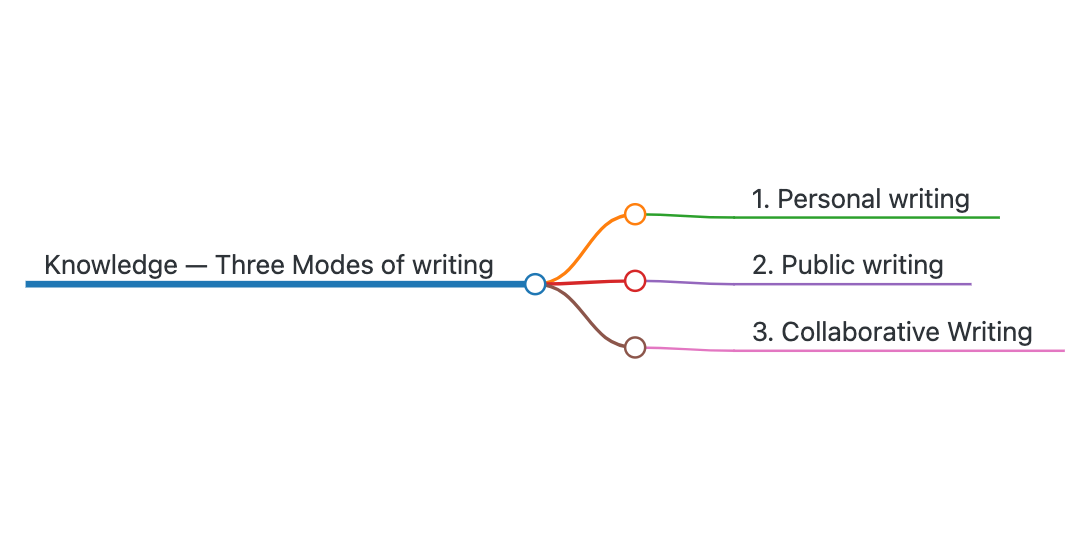
Three Modes of Knowledge Development 

1. Personal writing

For me that was Evernote, then for a while Google Docs, now Obsidian

Obsidian suits because of linking and tags. And because I’m  not combining it with tasks, and because I’m  not using it to store reference material or bookmarks.  I’m  also learning to process my thoughts more fully.

Later: Sunday, 20 March 2022 – I use it for Tasks.  But not for storing reference material.  with Dataview plugin I can add a task to any note, and it will be on the list of tasks.  I don’t think it interferes with my knowledge dev.  I can add tasks that are just about plans for that note.  Writing Plans.

2. Public writing

This blog has almost 30 years of my public note taking.  Psyberspace — my overgrown garden with indexes and categories.  For it to be public there must be readers, and this blog does have some, dear reader!

3. Collaborative Writing

Google Docs, there must be a better way!  Social Media done right?  Social Creation?  Comments on posts?  Relationships are always the hardest, the neglected…

Consider this however, that this post was stimulated by a whole movement of people engaged in PKM and theorising about it.  I’m  not just a lonely brooder.

The smell of ebooks

I love the smell of ebooks!  I collect them.  I highlight bits.  I pop bits into this blog. I have mostly Epub or Kindle versions.  I convert Kobi to epub  I find audio versions. All that is a form of sniffing!

Lately I have been delighted by Readwise.  They found all my highlights and let me review them a few every few days.  They also import them to Obsidian.  

Where they look like this:


The real treat is this: The Next Chapter of Readwise: Our Own Reading App

I’m on the list and I can’t wait!

If you like the smell of books you will get in the queue.

This post is one in the long tradition here of looking at the psyche in cyberspace, this Reader is a revolution in the psyche.


Folders for browsing, tags for search (or just search?)

It seems there is a debate about tags vs folders.  They are not mutually exclusive.  Here is a principle I adhered to for years:

Folders for browsing, tags for search.

So what really is the difference between the two?

Physical libraries have shelves and things are grouped (like folders).  Tags are really not possible.  So it might be good to brows the theatre section if you are into theatre.

Digitally the same applies you can’t browse one big pile, so put stuff into folders, but not too many (at least at the top level). Folders are there to facilitate browsing.  The Dewey decimal classification has 10 top levels, and that is about right.  They are rather beautiful:

000 – Computer science, information & general works
100 – Philosophy & psychology
200 – Religion
300 – Social sciences
400 – Language
500 – Pure Science
600 – Technology
700 – Arts & recreation
800 – Literature
900 – History & geography

But what about ‘Karl Marx’?  Browse in Social sciences. But there would be stuff about him or by him in probably everyone of those groups!  Hard for librarians who are forced to chose one shelf for something like: Sociometry, Experimental Method and the Science of Society, An Approach to a New Political Orientation by J.L. Moreno, which also has a chapter on Marx.  Digitally it could be in many at once i.e. in three folders: Moreno, social science and politics. That is worth doing. Some one browsing might like finding it there.  But consider the power of tags.

Tagging that book with: Moreno, politics, social science would be useful, but imagine adding sociometry, Marx, psychodrama group work, philosophy, religion.

It would come up in a fairly short list with any two of those tags. Also be easy to see what other books come up with a search on any two of those tags.

*

But what the hell!  Functionality for tags is lousy in most apps. They take time to add. Maybe search has outsmarted tags. Google does it all.

In Google Drive a file can be in many folders, that’s an an aid to browsing. No tags, and search works well.