This article in the Psychotherapy Networker makes some useful points. I found some useful, but I don’t think of myself as an immigrant in the digital world! That is who he addresses.
The revolution in communication technology has created a new set of ethical dilemmas, which—given the pervasiveness of Internet culture—are invading our sessions, whether we know it or not.
The question that got me thinking is When to Google a client?
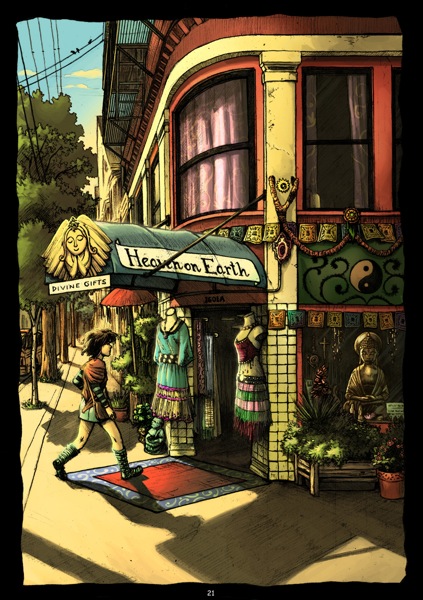
I’m reading the CBZ file in Comic zeal on the iPad. Nice. I’m about 50 pages into the 250.
Finding the free graphic novel, is interesting as it sort of ties in with his other themes. It is si-fi and the links back to the science are fascinating. I learned about Roger Penrose who I’d never heard of. There is a big debate obviously about consciousness, but from the wikipedia article I tend to go with Penrose. Thee is something weird about consciousness. I have an instinctive disdain for the value of neuroscience for psychotherapy – not for neuroscience but for the value people see in it for psychotherapy. However quantum science could change everything once we get the hang of it.
Its well done, a big collaborative production – with an interesting Kick-starter project for volume two.
Penrose has written books on the connection between fundamental physics and human (or animal) consciousness. In The Emperor’s New Mind (1989), he argues that known laws of physics are inadequate to explain the phenomenon of consciousness. Penrose proposes the characteristics this new physics may have and specifies the requirements for a bridge between classical and quantum mechanics (what he calls correct quantum gravity). Penrose uses a variant of Turing’s halting theorem to demonstrate that a system can be deterministic without being algorithmic. (E.g., imagine a system with only two states, ON and OFF. The system’s state is ON if a given Turing machine halts, and OFF if the Turing machine does not halt, then the system’s state is completely determined by the Turing machine, however there is no algorithmic way to determine whether the Turing machine stops.)
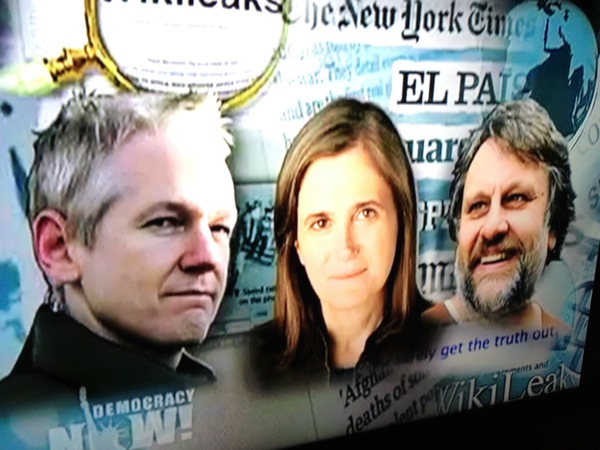
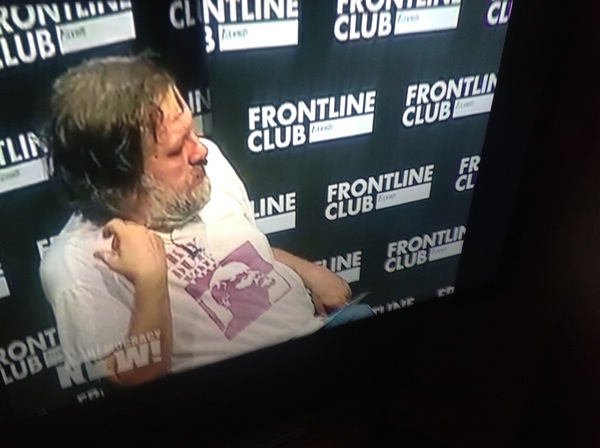
Amy Goodman from Democracy Now hosts this debate between Julian Assange and Slovenian Philosopher Slavoj Žižek — From the Troxy Theatre in London, July 2 2011. Also streaming in HQ from Democracy Now for those with faster lines. Brilliant debate!
I wish I’d got hold of this a year ago when it came out, but it is worth watching any time!
“Capitalism will have trouble with intellectual property” – Slavoj Žižek In the Amy Goodman interview with Julian Assange
Stimulating interview!
I’ve come away thinking that if property is theft then intellectual property is the most obscene form of theft, as it steals from us what is most human, our creativity and spontaneity.
Are we in an information age, or is this still the industrial age where the workers will create socialism? What is Slavoj Žižek saying here? If capitalism can’t cope with intellectual property then it can’t cope because of some new relationship of production?
If that is the case who is the new revolutionary class? Is it still the industrial proletariat?
What clout does any other class have?
Or is it that as the information sector becomes the most consumed sector of the total produce – eg Amazon can afford not to make a profit on hardware as it sells intellectual property – as does Google – then these companies – like newspaper and music companies will falter as consumers protest about the punishments metered out to people who share!
Not only that but people who create – lets not call it property but intellectual goods and services – are the most advanced producers of social production (recall Marx ‘s point that the contradiction in capitalism is that production is social and ownership is private). Look at the credits in a movie, while that creation is tied to hardware there is a way to pay the creators and for the middle men to cream most of that off. Even solitary creation like a novel or science is mostly people standing on the shoulders of giants. All creation is a mash up.
Capitalism inhibits creation.
Capitalism inhibits sharing.
Capitalism inhibits the distribution of culture.
But information, creation that is not thwarted by capitalism has already been co-opted by capitalism.
The potentially revolutionary class then is the creators, and that is all of us. As Clay Shirkey put it so beautifully following Marshall McLuhan The fundamental shift in the electronic world is that consumers become creators. Just pressing a Like button is on the lowest end of the spectrum of creativity, with great art and science at the other end, but it is on the continuum! There is a qualitative shift that was made with the Internet.
Perhaps the early slogan – Information wants to be free – is a forerunner of a class of creators becoming a class that is conscious. Releasing information is a crime, Bradley Manning, Kim Dotcom, the latter has become a local hero, because he is fighting the superpower and exposing New Zealand’s subservience.
For people to move fully into a world where information is the dominant item of consumption, and we are probably a long way off that, then a new relationship of production is called for. New relationships of creation. New ownership of the means of production, distribution and exchange.
Think of what that might mean, no copyright, new forms of socialized payment for creativity, no advertising to pay for content. Most of all education, news and culture in the hands of the creators would change everything. Intelligence in the CIA sense would be free, releasing information would be heroic. Secreting publicly beneficial information wld be a crime.
Where does the money come from to pay for all this…
Wait… Money is information, it is currently owned by the ruling class, they create laws (also information) to control all information, about the flow of money, and the creation of money,
This does require a new relationship for the means of production of physical goods. The same dynamics apply, (material) goods too want to be free, and goods too are created by the very people who use them (could the but afford them) Its is not about the nature of the goods we are dealing with here. It is labour power, let think of it all as creativity power. Imagine the force of an alliance of all people who create, but who do not own or share equitably in what they create.
Marx said little about the future – but he did say we could all have the leisure to be philosophers. Sounds like he had an inkling there of the implications of his perspective related to creating ideas.
I found this on the WayBack machine & thought I already had it in this blog, but it seems not. I will change the creation date so it show up as an old archive… sometime/maybe.
When I finished my ThousandSketches project I wanted to continue making sketches and blogging them. I created In this moment… My art blog In addition to my sketches I added thoughts about art, and a lot of links to art I like and bits of info about artists.
But really it is all Psyberspace! I may as well put it all here. Maybe I could just use ifttt to create links here when I post something on In this moment…. I’ll try that.
Noam Chomsky: that the April 6 movement in Egypt began as a group of tech savvy people working with workers on strike. They were squashed by the regime.
A surprise Arab drive for freedom, the West’s structural crisis and new hope coming from Latin America. That’s the modern world in the eyes of Noam Chomsky and Tariq Ali, two prominent thinkers and this week’s guests on Julian Assange’s show on RT.
If you’ve missed the previous episodes, you can always watch them online athttp://assange.RT.com
Another phenomena that struck me is the speed of the spread of the consciousness of change tips from hidden to visible.
~
Note industrialization that traditional Marxism addresses is perhaps more prevalent in China than in the USA. Design, IT development is separated from the material production. Perhaps the real motivation is that if all forms of creativity are integrated and work together the capitalist control can’t be maintained.
Chomsky: China is the assembly plant for the advanced state capitalist counties.
The soul, or psyche requires a medium. Without medium the soul is nonexistent. The psychodrama stage, the psychotherapeutic hour, the poem, and so on are psyber-media. Cyberspace is the ultimate medium for the soul, the realm where the gods live. Without adequate media for soul the gods are dead, there is no numinosity. The soul is evolving in cyberspace. Viewed in this way psyberspace is not a bad name for it.
That the soul is eternal, outside space and time, makes sense when viewed as a manifestation through this media. The power of the psyche is also manifest, in that media transforms the world. The invention of the printing press unconsciously transforming the world into its image, conveyor belts, moveable type pre-cursing all manufacturing and assembly of pars. Visualise the effect of the invention of paper, drawing boards etc. on the shape of buildings. The electronic manifestation of soul is right now soaking its influence into the world, restructuring organizations, theories of personal development, publishing, money, into a form analogous to its its digitally mediated life.
The future of digital culture—yours, mine, and ours—depends on how well we learn to use the media that have infiltrated, amplified, distracted, enriched, and complicated our lives. How you employ a search engine, stream video from your phonecam, or update your Facebook status matters to you and everyone, because the ways people use new media in the first years of an emerging communication regime can influence the way those media end up being used and misused for decades to come. Instead of confining my exploration to whether or not Google is making us stupid, Facebook is commoditizing our privacy, or Twitter is chopping our attention into microslices all good questions, Ive been asking myself and others how to use social media intelligently, humanely, and above all mindfully. This book is about what Ive learned.

 Amazon