The Heidegger-Buber Controversy: The Status of the I-Thou

The Heidegger-Buber Controversy: The Status of the I-Thou (Contributions in Philosophy) [Hardcover]
Haim Gordon (Author)

Amazon

This book is $96 in kindle!

I’m curious.

Perhaps in line with my hypothesis that Moreno has a solution to the problem posed by I-Thou for knowing and research.

I’ve got the kindle sample.

From the blurb:

The I-Thou controversy between these two thinkers is a significant but often overlooked issue in philosophy and theology. In one of the first books to truly address the subject, Haim Gordon explores the arguments of both Martin Heidegger and Martin Buber regarding the The I-Thou relationship and its significance for human existence. Gordon’s work illuminates Heidegger’s complex and enlightening ontology–one that describes the everyday life of the human in such a way that there is no place for the I-Thou relationship. Buber, on the other hand, argues for the significance of the I-Thou relationship within human existence, and highlights the ways in which Heidegger’s philosophy fails to grasp this important point. After examining the fundamental ontology of Heidegger, set beside the ontological insights of Buber concerning this relationship, Gordon concludes that each of these important twentieth-century philosophers was guilty of ignoring the contributions made by the other to the study of ontology and being.

By exploring the complicated dynamic between Heidegger and Buber, Gordon presents the reader with valuable insights and a deeper understanding of human existence and relationships. The implications of both this controversy and its resolution are far reaching for many other philosophical disciplines, including social and political philosophy, metaphysics, and ethics.

Klaus Krippendorff

http://en.wikipedia.org/wiki/Klaus_Krippendorff Wikipedia

Screen Shot 2012 10 07 at 2 11 28 PM

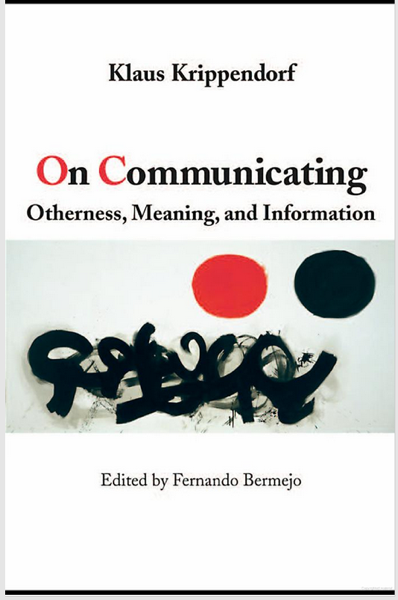
Amazon On Communicating: Otherness, Meaning, and Information [Paperback] Klaus Krippendorff (Author), Fernando Bermejo (Editor)

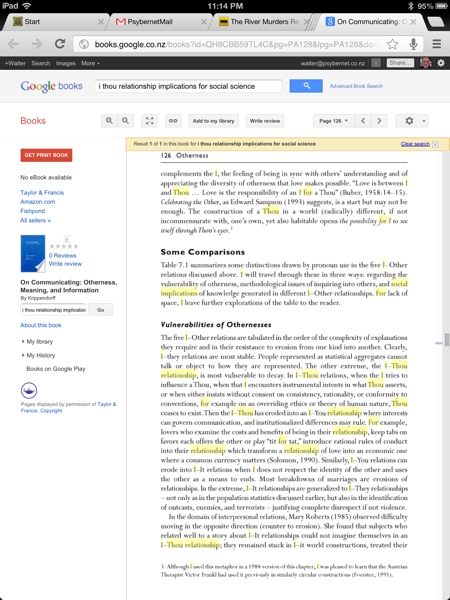
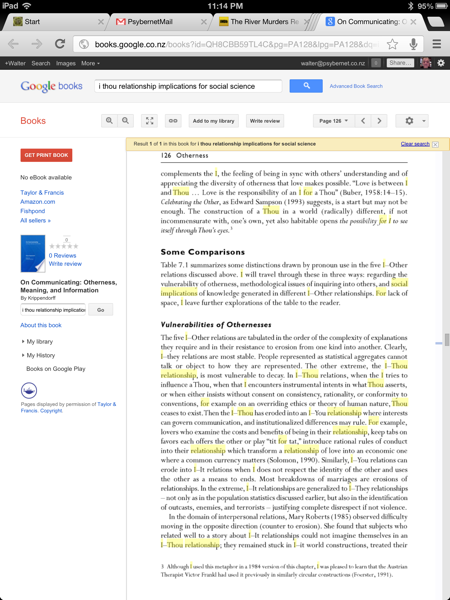
I’ve got the Kindle sample – looks interesting — the material available on Google books – pdf on the kindle – still can’t find the bit where he talks about the I-thou implications on research.

I did see that somewhere?

Yes, but the pages I saw are not available on the MacBook Pro – the iPad seemed to show them.

I might well buy the book. [ Later – Thursday, 11 October, 2012 – bought the Kindle version.]

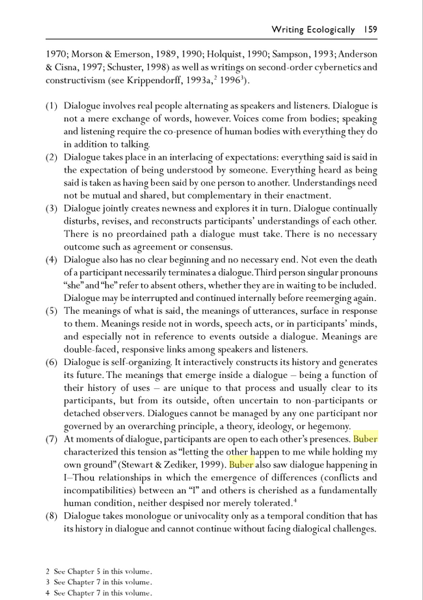
A clip from the Google book on the Mac is followed by two I got on the iPad.

Dialogue

Photo

Photo

Coevolution, invention, creation of the psyche – the relational paradigm

There is a flow in the evolution process.

Grass had to exist before grazing animals could evolve, they in turn had to precede carnivores.

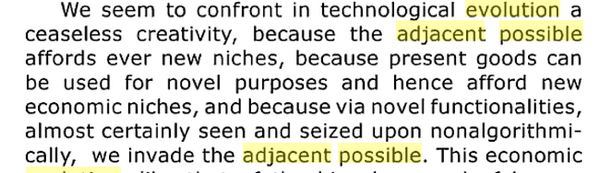
These examples perhaps are best expressed in the principle of the “next adjacent possible”.

A brief digression: I recently ran across a novel way to think about this question. In evolutionary theory, there’s a concept called the “adjacent possible,” coined by scientist Stuart Kauffman.

From this blog.

The “adjacent possible” refers to the change that’s available to you — i.e. adjacent, next door – versus the change that’s not.
Screen Shot 2012 10 07 at 1 24 29 PM

From Stuart A. Kauffman — Reinventing The Sacred Amazon

The process is holistically connected to the mutual adaptations in each species. Grasses develop ways to survive grazing. Herbivores evolve capacity to run, and carnivores develop sharper teeth and claws.

This idea is sometimes captured with the phrase co-evolution (Wikipedia):

In biology, coevolution is “the change of a biological object triggered by the change of a related object.”[1] Coevolution can occur at many biological levels: it can be as microscopic as correlated mutations between amino acids in a protein, or as macroscopic as covarying traits between different species in an environment. Each party in a coevolutionary relationship exerts selective pressures on the other, thereby affecting each other’s evolution.

Earlier post exaptation, a related concept.

I’m imagining this whole process as envisage the world of the psyche. The changing nature of how we relate to our being. Everything from collective rituals, art, monks meditating in a cave, group therapy, psychoanalysis, conjoint family week and couple therapy.

The investigations above, summed up as:

  • Adjacent possible
  • Coevolution
  • Exaptation

Imagine how these apply to the coevolution/invention/creation of the psyche.

(Why I say evolution/invention/creation is evident from this post about psyche this post about the nature of the psyche, about how it is not a thing, yet not nothing either, is relevant.)

Freud was before Jung. The idea of an unconscious and a method of working with it that was possible in the world was available to Freud as a medical clinician.

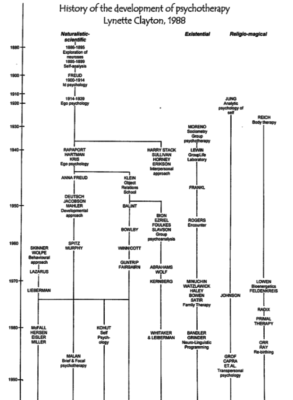
Moreno was in part a reaction to Freud. Group therapy and conjoint therapy was possible.

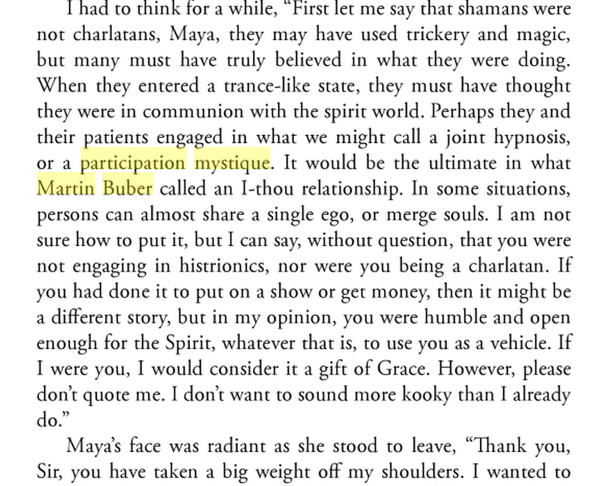
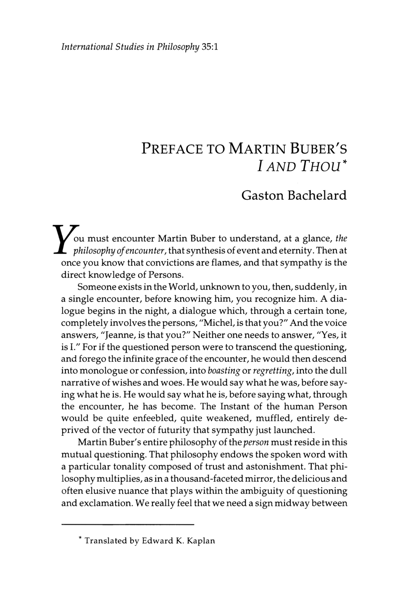
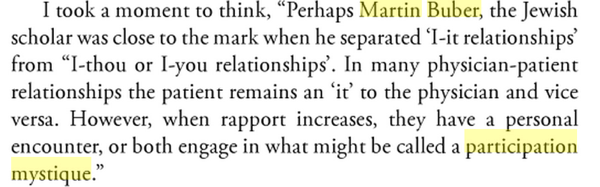
Moreno and Buber had found or invented an idea about the nature of the person being in the relationship.

Hendrix is pioneering the ice that being is relationship.

The relational paradigm is the now a niche that has opened, a shift in the culture and new ways of attending the the psyche are possible.

Moreno’s idea that this could well transform science is also on the cards as an I-Thou relationship with things is also possible according to Buber.

Doubling in Couple Therapy

I updated an earlier post today with just a few extra words about doubling. They are important to me though.

The question of psych-education and the relationship with the therapist continues to be something I reflect on. After the Dan Wile workshop I went on I see how much could be achieved with virtually no psych-ed, no dialogue, all doubling.

I also updated this post. Also with more on doubling.

I’ll post up more on this.

Debs Martin Comment On Mokihinui River | Stuff.co.nz


Screen Shot 2012 08 22 at 5 31 08 PM


Good piece in todays Press – quoted in full below. Here is a link to some snaps we took last year: http://www.flickr.com/photos/waltzzz/sets/72157628604924595/with/6589720617/

Debs Martin Comment On Mokihinui River | Stuff.co.nz:


Add Mokihinui River to national park

Plans to dam the West Coast’s Mokihinui River have been withdrawn but Forest & Bird’s Debs Martin argues that permanent protection is needed for the river and catchment.

Continue reading “Debs Martin Comment On Mokihinui River | Stuff.co.nz”

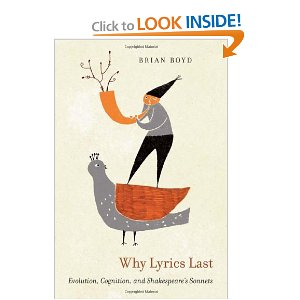
Shakespeare Sonnets – Evolution – Kim Hill – Brian Boyd (and relationship)

Loved this discussion:

Click to play & download Bryan Boyd Interviewed by Kim Hill

Here is the book:

Ref=sib dp pt

Kindle

I will read the book. But as I listened I was burning to join in on the discussion. I have since my days studying under Prof. Robert Bigelow in the late 60s at Canterbury had an understanding of “gene pools”. The concept makes sense of how some things might benefit the survival of a species even when individuals do not have more babies.

Brian Boyd touched on this lightly in the interview, I’ll be interested to see if he does this more fully in the book.

The point is this: if lyrical poetry (or anything else) is useful to the group then only a few need to have a gene for it, and even if they individually don’t have more babies, the group as a whole might survive and a neighbouring group who does not have that gene in their pool might not.

I’ve been thinking about this in relationship to the purpose of monogamy. It seems that it has a special place in healing wounds from childhood. But this typically does not happen till after the crucial childbearing years, in the second reflective half of life. I think of the powerful impact even one or two healing couples can have in a group. They can foster relationship education as well. They might influence psychological health, and more robust grandchildren.

PS

Bigelow’s book here: Amazon – The Dawn Warriors

EFT – three steps

 
  • Stabilisation
  • Restructuring
  • Integration
 

Stages and Steps in the EFT process

1. Stabilization (Assessment and De-escalation Phase) Step 1: Assessment Step 2: Identify negative cycle and attachment issues Step 3: Access underlying attachment emotions Step 4: Reframe the problem into cycle, attachment need and fears — Partners are no longer victims of the cycle, they are now allies against it.

  • During this stage the therapist creates a comfortable and stable environment for the couple to have an open discussion about any hesitations the couples may have about the therapy, including the trustworthiness of the therapist. The therapist also gets a sense of the couples positive and negative interactions from past and present and is able to summarize and present the negative patterns for them.

2. Restructuring the bond (the change phase) Step 5: Access implicit needs, fears, models of self Step 6: Promote acceptance by other-expand the dance Step 7: Structure emotional engagement-express attachment needs and wants

  • This stage involves restructuring and widening the emotional experiences of the couple. This is done through couples recognizing their attachment needs, and then changing their interactions based on those needs. At first their new way of interacting may be strange and hard to accept, but as they become more aware and in control of their interactions they are able to stop old patterns of behavior from reemerging.

3. Integration/Consolidation Step 8: New positions in the cycle/enact new stories Step 9: New solutions to pragmatic issues

  • Focuses on reflection of new emotional experiences and self-concepts. It integrates the couple’s new ways of dealing with problems within themselves and in the relationship. It is the attachment bond that is formed through EFT therapy, which is the newfound strength of the couple[8].[9]

Seven Transforming Conversations – 7 Conversations

 
More from Susan Johnson


Seven Transforming Conversations:

Recognizing Demon Dialogues—In this first conversation, couples identify negative and destructive remarks in order to get to the root of the problem and figure out what each other is really trying to say.

Finding the Raw Spots—Here, each partner learns to look beyond immediate, impulsive reactions to figure out what raw spots are being hit.

Revisiting a Rocky Moment—This conversation provides a platform for de-escalating conflict and repairing rifts in a relationship and building emotional safety.

Hold Me Tight—The heart of the program: this conversation moves partners into being more accessible, emotionally responsive, and deeply engaged with each other.

Forgiving Injuries—Injuries may be forgiven but they never disappear. Instead, they need to become integrated into couples’ conversations as demonstrations of renewal and connection. Knowing how to find and offer forgiveness empowers couples to strengthen their bond.

Bonding Through Sex and Touch—Here, couples find how emotional connection creates great sex, and good sex creates deeper emotional connection.

Keeping Your Love Alive—This last conversation is built on the understanding that love is a continual process of losing and finding emotional connection; it asks couples to be deliberate and mindful about maintaining connection.