Mirroring

Mirroring is a word used in both the Psychodrama and Imago modalities. In a classic psychodrama the protagonist returns to the audience and is companioned by the conductor of the drama, who instructs the auxiliary egos to re-enact the scene. This can be done for a variety of reasons. One is to reveal to the protagonist how their actions look from another perspective. Another reason might be at the end of a drama or role training session for the protagonist to see the new development in their being. The mirroring in the Imago sense shares these purposes though the form different.

I’m finding it helpful to think of two mirror positions.

1. Face to face

2. Spectator

Here is a quote from Moreno highlighting the spectator mode.

The technique of the mirror ‘portrays’ the body image and the unconscious of A at a distance from him so that he can see himself. The portrayal is done by an auxiliary ego, who has made a close study of A. … In the mirror technique the protagonist is a spectator, an onlooker, he looks at the psychological mirror and sees himself. Fig 4(Moreno, J.L., 1959, p. 53).

Here is an example from Peter Kellerman:

“.. Bob presented a scene in which he quarreled with his wife. He stated his case and argued that she did not pay enough attention to him and neglected his needs. A woman in the role of his wife presented the other side of the story, throwing fuel on the already overheated marital conflict. And so it went on in what seemed to be an endless battle of words and accusations. The director used the mirror technique in an effort to break the deadock. He asked Bob to step out of the scene and watch it all from the outside (as if in a mirror), with another man playing the role of himself.

Watching the fight as a spectator, Bob listened carefully to both partners. ” Page 92

Peter Kellerman also gives an example of mirror that is face to face.

“A group member to another: When I meet you, I feel enriched. Because you look at me from another perspective. Page 92

The purpose of mirroring

I can see two broad, slightly different purposes of mirroring.

1. Revelation

2. Validation

The first is so the person can see themselves either from a new perspective or how others see them. The second is to assist the person to have a sense of being seen and understood,and having value.

Both types have an existential quality, the person will get a sense they exist.

Mirroring becomes a very broad category we think of the whole field. As the term is used in all these ways within psychodrama and in other modalities I think it is useful to be able to distinguish the various processes that are called mirroring. Most examples of mirroring would fit into one of the following four combinations of form and purpose.

  Face to face Spectator
Validation    
Revelation    

Hand signals

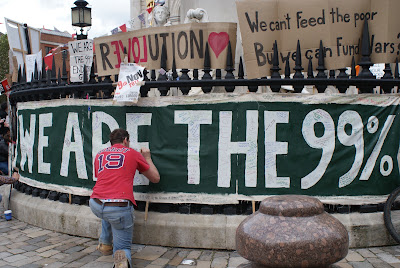
Hand signals have come into their own more than ever before, thanks to the prohibition of megaphones.  Human megaphones must have been in use in ancient times, but they are back!  Its wonderful how every act of the old system is back firing right now.  Police brutality is bringing more people into the movement.  Creating a puppet like Obama is driving class consciousness forward, banning megaphones creates simpler and more effective communication, just whats needed to augment mobile phones!

The Most Popular Hand Signal at Occupy Wall Street

Oct 12, 2011 J. Webster

Sure, at Occupy Wall Street, protesters are forced to use some complicated hand signals and tricky ways of getting their message across since they’re not allowed to use mics, but there’s one simple gesture that seems to be the most popular: the middle finger aimed at the financial elite. Yes, it’s a very good gesture, since everyone understands it right away and there’s no need for a megaphone.

Why does the occupy movement work?

Various reasons have been put forward for the success of the occupy movement around the world, and one in this article seems to be on the mark. Essentially Obama’s slogans of change and message of hope, though coming from the mouth of someone bought by Wall Street, are bigger than the man. He did not invent the lines, “Yes we can!” “Be the change” and while those words were effectively stolen, the sentiment was not.

The article also reports some interesting material on a survey of attiude towards capitalism.

Naked Capitalism

David Graeber: On Playing By The Rules – The Strange Success Of #OccupyWallStreet

Continue reading “Why does the occupy movement work?”

The Group and its Protagonist – Archetypes of Cyberspace

I completed this psychodrama thesis in 1999 after working on it one way and another since about 1984. One feature of this paper is the discussion about the sociometric matrix, a notion that influences my ideas about cyberspace as well and were at the root of another essay I wrote – Archetypes of Cyberspace

I stumbled across this better pdf version of the The Group and its Protagonist – linked to it on my Writing page.

I’m wonering if there is some way to publish something based on these papers?

Occupy London

From Lenin’s Tomb

Readable & interesting report & comment here on Occupy London. While it may be a “punctuating moment” iI seems a very important one as the whole theme of this is like no other demonstrations I have seen, it is against capitalism, like the ones at the global summits, but this time there is no global summit, it global capitalism full stop. The slogan of the 99% is also very unifying, and makes a potent point.

This isn’t a revolutionary situation, but merely a punctuating moment in the temporal flow of class struggle. But the purpose of slogans mentioning ‘Tahrir Square’ is to accentuate the internationalism of the movement, to point to its deep systemic roots, to express solidarity with the Arab Spring, to hope that this is the beginning of our own Spring, and to identify the commune as the political form of these aspirations. At the most prosaic level, it expresses the movement against austerity in its most ‘political’ moment, complementing the ‘economic corporatist’ moment of trade union struggle. It identifies the political class rule of the 1% as the key problem; the colonization of the representative state by big capital. And it proposes its own direct democratic answer.

Exaptation – copy & paste in the evolution of tech and culture

Just got a name for something I have grasped for a long time. I used to call it accidental by products of evolution, and had this idea when I was doing biology aged 15. EG the piano is a by product of the evolution of fingers. We as humans have gone beyond what was biologically fittest, accidental by-products just heaped upon themselves and interacted with each other to enable creativity and consciousness.

From What Technology wants by Kevin Kelly page 50: “These inadvertent anticipatory inventions are called exaptations in biology.”

“Exaptation is a term used in evolutionary biology to describe a trait that has been co-opted for a use other than the one for which natural selection has built it.”

“It is a relatively new term, proposed by Stephen Jay Gould and Elisabeth Vrba in 1982 to make the point that a trait’s current use does not necessarily explain its historical origin. They proposed exaptation as a counterpart to the concept of adaptation.

For example, the earliest feathers belonged to dinosaurs not capable of flight. So, they must have first evolved for something else. Researchers have speculated early feathers may have been used for attracting mates or keeping warm. But later on, feathers became essential for modern birds’ flight.

It is a relatively new term, proposed by Stephen Jay Gould and Elisabeth Vrba in 1982 to make the point that a trait’s current use does not necessarily explain its historical origin. They proposed exaptation as a counterpart to the concept of adaptation.

For example, the earliest feathers belonged to dinosaurs not capable of flight. So, they must have first evolved for something else. Researchers have speculated early feathers may have been used for attracting mates or keeping warm. But later on, feathers became essential for modern birds’ flight.

(Perry, 2013)

In the evolution of technology and culture it is all exaptation. The reason is that the basis of tech and cultural evolution are not genetic, the information is carried by social means. Thus nothing goes extinct, and all innovations can be resurrected. In other words we can cut and paste to make new things, that process is far faster and more efficient than evolution in the biological sphere. Sexual reproduction is a form of cut & paste, but still far more primitive than what we can do with our inventions.

For example: Id love to graft the Graffiti handwriting system from the dead Palm onto a current smartphone.

References

Parry, Wynne. (2013, September 16). Exaptation: How evolution uses what’s available. Retrieved February 8, 2016, from http://www.livescience.com/39688-exaptation.html