Good communication & Psychotherapy

I see two qualities as essential to psychotherapy:

  • The crucible of the relationship. This is formed through the engament process and framed by purpose, time and money agreements.
  • Attention to the unconscious. Work with dreams & transference (perhaps better but more obscurely phrased as the isomorphy of dynamics.)

I educate about communication in relationship. I have done it since the early 80s , but with my enthusiasm as I learnt to work more fully with the crucible & the unconscious, I took this aspect for granted. I have also wondered at times if I was too interventionist, thus creating unnecessary transference.

Right now I want to claim it as useful, important. It is right to teach cognitive psychological material if the client will benefit from that. Then comes the crucial question what to teach? What is in the manual? How to teach it?

Some principles:

Firstly the crucible, the therapeutic relationship and unconscious processes must come first, or there will be no sustained deep work.

The educative work can be integrated into the psychotherapy.

And what is worth teaching? This must be under constant review as just what is good communication an art.

Recently I discovered Marshall Rosenberg, the whole NVC system is worth learning. See my earlier post.

Dialogue process as taught by Harville Hendrix is worth knowing. Here is a description of the Intentional Dialogue by Dawn J. Lipthrott.

There are dozens of principles of good communication in Transactional analysis. They have become part of my being over the years but I leaned about them first in an out of print book by Hogie Wycoff. There is a paper on the net that covers some of that: The Theory and Practice of Cooperation. One that is central to this paper and good communication is the understanding of the Karpman triangle

One of the difficulties many people face is that rather than learning about effective communication they learn ideas about “positive thinking”, and even “assertiveness”. They so easily lead to problems. “Positivity” misused, can cover pain & lead to annoyance when others express pain. Such tools in the culture are readily used to cope, but they do not enable deeper connection, they do not allow needs to be clearly identified. “Assertiveness” misused, can prevent the attitude put forward by Rosenberg, that we focus the needs of both parties. Over coming the forces in the culture that foster poor communication is an essential part of psychotherapy in my opinion. As both Rosenberg and Wycoff point out many of these linguistic modes are based to sustain a culture of dominance and submission.

Teaching is most needed & relevant long before clients arrive for help. The arrive with psychological trauma of adverse relationships in their lives. They maybe in deep pain and not receptive to learning. Yet at those times we can model, re-frame in language that leads to insight. For example (and I’ll just offer one for now), when someone confuses think and feel, in the active listening the therapist can untangle it:

“I feel no-one loves me”

You think no one loves you, I imagine you feel sad when you think that.

Email on iPhone Question

I have my own email server and use pop3 from that in Thunderbird on the PC. I have used Gmail to backup all my email on the web. I have not used the Gmail account other than that until now.

I have synced my Gmail with the iPhone. That works well. I can do things on the iPhone and they are also done on the Web.

BUT

I would also like to have Thunderbird, managed in the same way synced in with the Gmail. I need an offline mirror of my email as I have poor web access at times.

~

Obviously IMAP or something is needed, that is available through my web host.

Just what is involved there? Any recommendations?

Later: Monday, 29 September, 2008

I have used DreamHost to move my email ovewr to Gmail Imap. I access it through Thunderbird. on the PC, all seems to work OK. Filtering like mad to get just what I want in the inbox, working pretty well! There are still some confusing folders but I’ll get there I think.

iReading

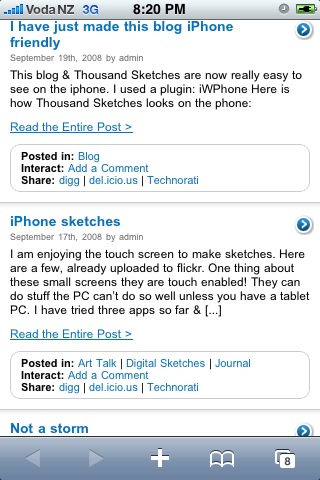
This blog is not called Psyberspace for nothing. I have all sorts of phases of enthusiasm, and they wax and wane, but “exploring the psyche in cyberspace” is always present. My sense if that the iPhone has enabled a shift in the “space”. The Palm initially untethered me from the PC, but the iPhone makes good where Palm lost the plot. I have had my phone for a few days but feel very liberated… esp in the reading dept. I am writing this on the PC, I can’t do it on a phone, but reading is another story, it is great, and I do it in bed, in cafes, waiting in lines.

The net is adapting to the phone in a way that is quite remarkeable, surfing on the palm was almost impossible, and very wew sites optimised for Palms. But with this new gadget it is different! Cyberspace is making a shift, perhaps not quite everting, but moving from the mud onto land.

I find myself reading the following all optimised for the iPhone in some way, I will post more specific reading reviews, partly to get more familiar with the various, sometimes complex processes to get stuff on the phone.

  • Books
  • Blogs in a feed reader
  • iWPhoned WordPress blogs
  • Wikipedia via an app
  • Amazon, optimised automatically, good for reading reviews.
  • Web Pages optimised through Instapaper

All in all it is pretty good! I could add Twitter & Facebook, though that is not really reading, but they work well!

PS Imagemaking is also liberated with a touch screen, I will write that up in an iSketch category on my Art Blog.

iPhone sketches

I am enjoying the touch screen to make sketches. Here are a few, already uploaded to flickr. One thing about these small screens they are touch enabled! They can do stuff the PC can\’t do so well unless you have a tablet PC. I have tried three apps so far & they are each delightful in their own way! Having used different apps (!) on my tablet it is amazing how different tools warm me up to different things.Free app: DoodleIt

\"DoodleIt\"\n\n\"DoodleIt\"\n\niGraffitti\n\nHas an interesting shadow feature. Also has a website they can go to\n\n\"photo.jpg\"\n\n\"I\'ve\"\n\n\nNetsketch \nThis one is vector based and so it is easy to scale! Have never mastered this on the PC. Also has a website gallery: my.netsketchapp.com\n\n\n\"Netsketch\"\n\n\nThere is an art pool on flicker for iPhone sketches\n\n\n\n

Thanks Lisa Rivas!

I am going through the calmest time in my art binge since the seizure began more than two years ago. I did the Thousand Sketches in one year and continued to make digital sketches and do some real-media work in the last year. I have had three exhibitions of one sort and another this year – one is still going at OurCity Otautahi. But it is a month or so since I posted an image, and that is the longest time. I am not dreaming art every night. I have no more plans for workshops or shows this year, and am enjoying being focused in my psychotherapy work. Calm. Before a storm? I doubt it, not this year anyway, I am in recovery mode from having been invaded by enthusiasm!

So this is a very belated thank you post.

On my mind for a while is the delight in getting “I love your blog” award from Lisa Rivas, whose work I love! This is what an I love your blog award looks like. See image below.

Prompted by that viral award I decided to do some heart art as well. I’ll put it in the next post, and I will also send out a few I LOVE YOUR BLOG awards. I will post a list when I have seven & I get time to really suss out some great art blogs I know.

award