Milton Glaser’s Great Rules For Life

I like his work! And these “rules” make a good read.

Nice video here. hilmancurtis

Milton Glaser’s Great Rules For Life « Saskia Wilson-Brown http://saskiawilsonbrown.com/2010/07/28/milton-glasers-great-rules-for-life/

(Sent from Flipboard)

Unfortunately in our field, in the so-called creative – I hate that word because it is misused so often. I also hate the fact that it is used as a noun. Can you imagine calling someone a creative? Anyhow, when you are doing something in a recurring way to diminish risk or doing it in the same way as you have done it before, it is clear why professionalism is not enough. After all, what is required in our field, more than anything else, is the continuous transgression. Professionalism does not allow for that because transgression has to encompass the possibility of failure and if you are professional your instinct is not to fail, it is to repeat success. So professionalism as a lifetime aspiration is a limited goal.

Diary

Found this in my jumble. Bought back the memory of that trip to Sydney

Editing Posts on this blog

It may or may not be a good practice, but I often post half finished posts, then edit later, often years later! But mostly minutes or hours later. If there has been discussion i wont tamper with the context. if it is years later i might insert a date to show the progression.

The point is that the RSS feed which sends the whole post (currently) is often the worst way to read this blog.

I will set it to post a snippet only. That way the reader will need to come to the blog, where there is often a more completed post, with more links and images. (and less bad grammar and typos).

Body and Soul

Linda Stone (reference) is aware of the changes in the body / mind in our psyberspace. She does not lament it but is inspirational as to how to drive on though the difficulties of poor breathing & posture and other negative affects on the body.

That is one of the reasons I see the iDevices as steps in the right direction. “What more screens?” Yes, one while I walk, one I can have with me to write, read and draw “Plein Air”. Liberation from the desk.

World, relationships, information, art, absorbing, creating all converging in an immersive movie of the soul.

Abstract Expressionist Women

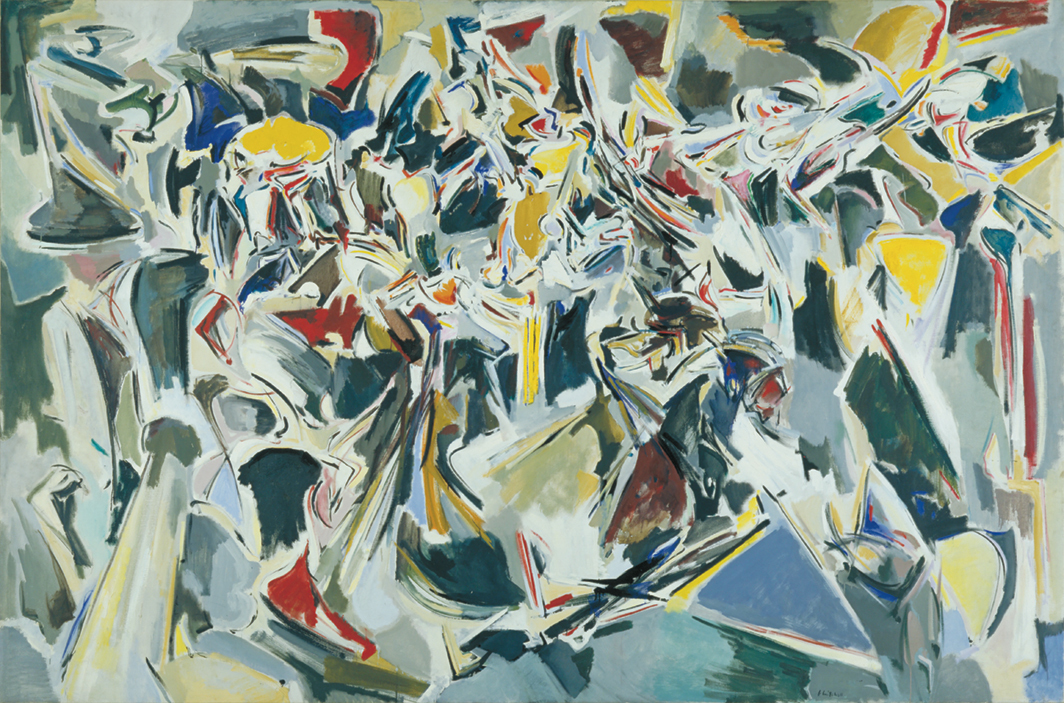
Feature image: Joan Mitchell, Cross Section of a Bridge, 1951, oil on canvas, 79 3⁄4 × 119 3⁄4″. © Estate of Joan Mitchell.

Postage Stamps, Abstract Expressionism and Joan Mitchell:

(dead link)

The ten artists included in the stamp series are Hans Hoffman, Adolph Gottlieb, Mark Rothko, Arshile Gorky, Clyfford Still, Willem de Kooning, Barnett Newman, Jackson Pollock, Robert Motherwell and Joan Mitchell. Joan Mitchell (1925-1992) is the only woman in the group, though her contemporaries Elaine de Kooning, Helen Frankenthaler and Lee Krasner certainly could have found their way to abstract stamp glory as well. Joan Mitchell, however, is a great choice, a unique talent and appealing conversationalist as transcribed here in a 1986 interview with Linda Nochlin. Joan was born in Chicago, went East to Smith College and while there watched Rufino Tamayo paint a fresco in the art library; she returned to Chicago to study at the Art Institute, sojourned to New York then traveled to Mexico and Paris, Cuba and Haiti, then back to New York, though France would eventually become her home base.

Joan Mitchell – Wikipedia, the free encyclopedia:

Joan Mitchell (February 12, 1925 – October 30, 1992) was a ‘Second Generation’ Abstract Expressionist painter. Along with Lee Krasner, Grace Hartigan, and Helen Frankenthaler she was one of her era’s few female painters to gain critical and public acclaim. Her paintings and editioned prints can be seen in major museums and collections across America and Europe.

Another article on Joan Mitchel:


https://www.artforum.com/print/202102/molly-warnock-on-the-art-of-joan-mitchell-85006

Charlotte Park: Abstract Expresionist Paintings, 1950-63 – Hamptons.com:

Charlotte Park: Abstract Expresionist Paintings, 1950-63 — By Exhibition May 25 – June 26, 2006

Charlotte Park
Untitled, ca. 1951
Oil and gouache on muslin, 22 x 30 inches
Signed lower right: C. Park

(dead Link to the painting.)

Spanierman Gallery, LLC is pleased to present Charlotte Park: Abstract Expresionist Paintings, 1950-63. Curated by the noted art critic and scholar Ronny Cohen, this exhibition presents the most extensive survey of the Abstract Expressionist art of Park to date, featuring her paintings and drawings from the 1950s through the early 1960s. Many of the works have rarely or never been on view, providing new ways of considering the artist and her oeuvre. A brochure by Cohen discussing Park, her work, and her relationship within the context of the Abstract Expressionist movement accompanies the exhibition.

Park’s dynamic all-over style of composition, with its rich repertory of abstract shapes and bold imaginings, made its appearance in the early 1950s. From the beginning she put her own personal stamp on Abstract Expressionism, demonstrating through her art how profoundly well she understood the character of the movement and its means for reshaping reality and for discovering the essence of form and content. The irregular shapes appearing initially in Park’s works have as a general antecedent, the animated forms in the emergent Abstract Expressionist paintings of the late 1940s, such as those of Mark Rothko. Eventually Park evolved these shapes into a central feature of her painterly vocabulary, and the paintings in gouache that she created in the mid-1950s, in which references to nature on eastern Long Island appear, are revealing of the emblematic kinds of meaning with which she endowed her art. The wavy lines and twisty organic shapes in her works can be seen as the marks of a lively and commanding gestural hand, while the way that these forms sweep across the brilliant surfaces of a number of her gouaches of the mid-1950s can also be taken as the fascinatingly reductive signs of the ocean, bay, and countryside of Long Island.


Later
Tuesday, 07 September 2021

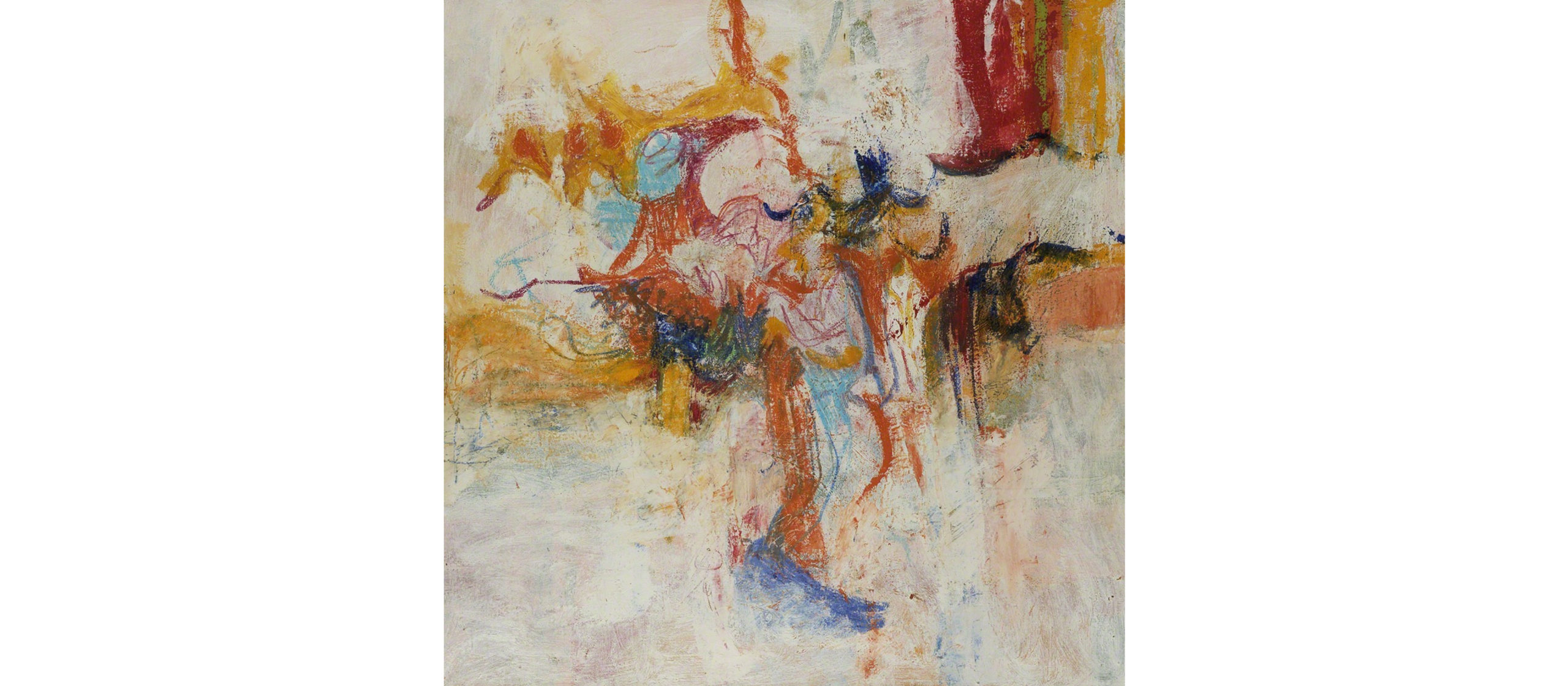
Untitled, ca. 1959
Oil and oil crayon on canvas
30 1/4 × 30 1/4 in
76.8 × 76.8 cm

https://www.artsy.net/artwork/charlotte-park-untitled-37

Relational Reading

I understand something is changing in our psyche / brain with respect to focus. It is much harder to read books! There are so many articles and blog posts that lament his process. Maybe something is lost, but so much more is gained. It is a lemarkian step in our evolution. Yes we can change psyche, and do to adapt to a new environment. We have such a wonderful capacity for fluidity. I am thankful I am a creature that can evolve!

We are now differently abeled. This process is not new. Media impacts psyche. Photography changed portraiture. Writing changed the oral traditions. Cinema changed theatre. Television changed cinema. Cinematic literacy impacted on the psyche. Old movies are slow! There must be a market in re-editing them for the contemporary soul.

Books are like old movies. We have moved on. Today we read in a relational way. We read a quote by a friend from Moby Dick, with a link to the whole book, we can search for snippets, or read the condensed version, flick to a trailer of the movie, read the reviews, and search, tweet, re-tweet, Instapaper and blog as we go.

This is lamented?!

But don’t get me wrong. There is nothing that will replace a good book, or an old movie for that matter. The context has changed, expanded.

We are still learning how to be here.

~

There are items like this one on how to train yourself to be in the dark:

http://infovegan.com/2010/07/26/how-to-focus

Like all exercise, different kinds of workouts work differently for different people. For me, interval training works wonders— this blog post, for instance, has taken me 70 minutes to research and write — ordinarily a blog post like this before I had this set-up would take me nearly a full day’s worth of work. More importantly though, I’m able to do things like read long articles or even academic papers — things I never used to “have time for” which really meant “had attention for.”

Look at the words in this: Distracted, shattered…

Author Nicholas Carr: The Web Shatters Focus, Rewires Brains | Magazine http://www.wired.com/magazine/2010/05/ff_nicholas_carr/all/1

The Internet is an interruption system. It seizes our attention only to scramble it. There’s the problem of hypertext and the many different kinds of media coming at us simultaneously. There’s also the fact that numerous studies—including one that tracked eye movement, one that surveyed people, and even one that examined the habits displayed by users of two academic databases—show that we start to read faster and less thoroughly as soon as we go online. Plus, the Internet has a hundred ways of distracting us from our onscreen reading. Most email applications check automatically for new messages every five or 10 minutes, and people routinely click the Check for New Mail button even more frequently. Office workers often glance at their inbox 30 to 40 times an hour. Since each glance breaks our concentration and burdens our working memory, the cognitive penalty can be severe.

(via Instapaper)

Walter

iPad & Art

This popped up on RWW today:

iPad Art: Who Says You Can’t Create With The iPad!:

The iPad has taken the tech world by storm this year. In a half-year poll, ReadWriteWeb readers voted it the most important product of 2010 so far. One of the few criticisms of the iPad has been that it’s mostly a media consumption device. It doesn’t have a camera and writing on the iPad is akin to walking on the moon (everything happens in slow motion).

However, the iPad has gained popularity in the artistic community – in particular thanks to an iPad app called Brushes, which enables you to ‘finger paint’ a colorful work of art.

It is a great tool – that’s why I’ve just got one. Brushes on the iPhone is OK, I prefer Layers and Sketchbook, but I’m upgrading them all to iPad versions.

The big drawback is pressure sensitivity, which puts it way behind any wacom based screns like my M200.

Just did my iPad first doodle today.

Google (custom domain) Calendar on iPad

It has always worked so well on the iPhone I’ve forgotten how I did it.

For some reason my Gmail (custom domain) works instantly in the iPad, I’ve forgotten how I did that already!

But I am now setting up the Google (Custom Domain, apps docs, whatever they call it!! – How about Google Live? Google Cloud? Google Everywhere? To hard to name: Gapps?)

Short answer, worked instantly:

How to Add Google Calendar to Your iPad

Maybe this that I had already tried

http://www.google.com/calendar/hosted/psybernet.co.nz/iphoneselect

had a part to play.

Anyway it works

The MS Exchange way did not, however I had to get my Contacts working using MS exchange.