
2
iPad & Art
This popped up on RWW today:
iPad Art: Who Says You Can’t Create With The iPad!:
The iPad has taken the tech world by storm this year. In a half-year poll, ReadWriteWeb readers voted it the most important product of 2010 so far. One of the few criticisms of the iPad has been that it’s mostly a media consumption device. It doesn’t have a camera and writing on the iPad is akin to walking on the moon (everything happens in slow motion).
However, the iPad has gained popularity in the artistic community – in particular thanks to an iPad app called Brushes, which enables you to ‘finger paint’ a colorful work of art.
It is a great tool – that’s why I’ve just got one. Brushes on the iPhone is OK, I prefer Layers and Sketchbook, but I’m upgrading them all to iPad versions.
The big drawback is pressure sensitivity, which puts it way behind any wacom based screns like my M200.
Just did my iPad first doodle today.
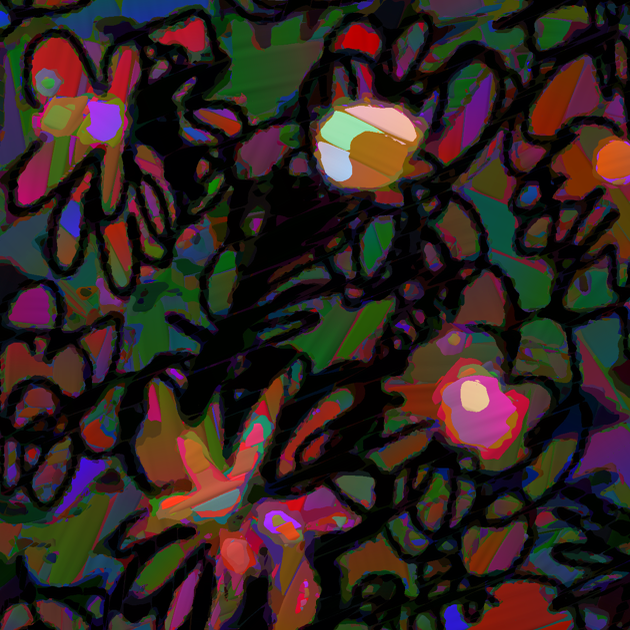
iPad Flower
First go on the iPad. Did not really like the doodle but then put it through an app. & tweaked it a bit…
Anyway here it is!
Google (custom domain) Calendar on iPad
It has always worked so well on the iPhone I’ve forgotten how I did it.
For some reason my Gmail (custom domain) works instantly in the iPad, I’ve forgotten how I did that already!
But I am now setting up the Google (Custom Domain, apps docs, whatever they call it!! – How about Google Live? Google Cloud? Google Everywhere? To hard to name: Gapps?)
Short answer, worked instantly:
Maybe this that I had already tried
http://www.google.com/calendar/hosted/psybernet.co.nz/iphoneselect
had a part to play.
Anyway it works
The MS Exchange way did not, however I had to get my Contacts working using MS exchange.
GroupWise on iPad
Apparently there is this app for mail and they make another one for docs.
GW Mail for iPhone, iPod touch, and iPad on the iTunes App Store:
Description GW Mail is a GroupWise email client for the iPhone. With this app you get a much better interface than Novell delivers by default through GroupWise WebAccess. This app gives you some of the enterprise features that you wouldn’t get with simple POP/IMAP – like access to your Frequent Contacts and GroupWise address book.
Hugh Wilson

Hugh Wilson (botanist) – Wikipedia, the free encyclopedia:
Hugh Dale Wilson (born 1945) is a New Zealand botanist. He has written and illustrated a number of books about New Zealand plants. He manages Hinewai Reserve on Banks Peninsula.
My friend Hugh. On Wikipedia!
He probably won’t tread this as he is a luddite. His motto could be “I am a luddite so you don’t have to be”, But its not. He sets an example as to how to save the planet.
Fluid form
Edge: THE MATHEMATICS OF LOVE: A Talk with John Gottman:
(JOHN GOTTMAN:) I look at relationships. What’s different about what I do, compared with most psychologists, is that for me the relationship is the unit, rather than the person. What I focus on is a very ephemeral thing, which is what happens between people when they interact. It’s not either person, it’s something that happens when they’re together. It is like a structure that they’re building by the way they interact. And I think of it that way, almost like a fleeting architectural fluid form that people are creating as they talk to each other, as they smile, as they move.
So Gottman too! The relationship is the unit, the locus of the therapy not the individual people.
~
I expect a heap of posts will automatically appear below so no need to say more!
Later But they didn’t, not as I expected. This quote is related to an earlier post of mine: https://psyberspace.walterlogeman.com/2010/people-myth/
My Tweets 2010-07-19
- bishop blesses river stones in water protest /
MacKenzie Guardians http://instapaper.com/zza0duf8 #
Powered by Twitter Tools
Bad Apple?
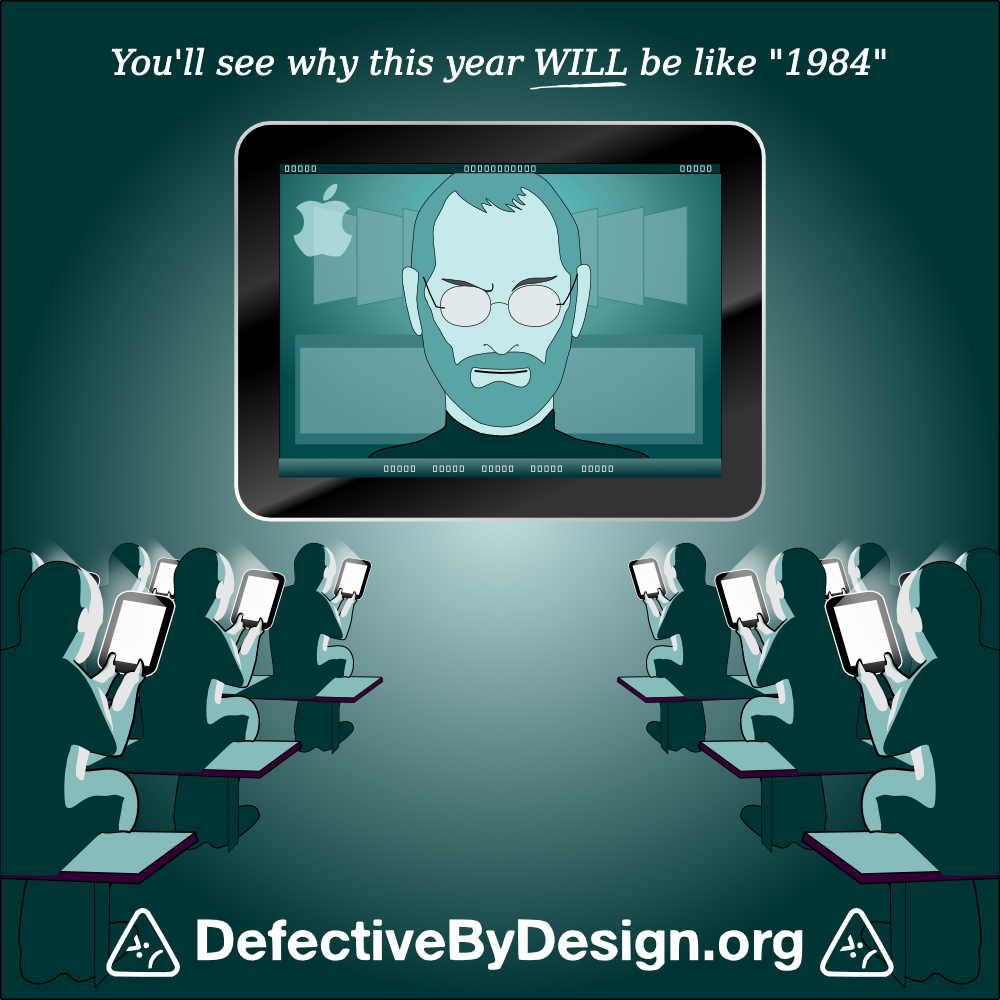
Love that poster. Love that there are groups and people who say these things:
Interview with DefectiveByDesign – The Digital Music Weblog:
DefectiveByDesign:
1) You will lose control of your hardware. The corporations imposing DRM systems will be in control of your computer and electronic devices, restricting your actions and monitoring you.
2) You will lose your traditional rights. You will lose the right to sell the music/video/e-books you thought you purchased, and you won’t be able to make private copies or backups or share with family and friends.
3) You will have additional privacy concerns. Your personal viewing/listening/reading habits will be available in the same way that your telephone records now are.
Welcome — Free Software Foundation — working together for free software:
A strong free software movement focused on the principled issues of software freedom — and a strong FSF in particular — will determine what freedoms the next generation of computer users enjoy. At stake is no less than the next generation’s autonomy.
— Benjamin Mako Hill, writer, technologist and FSF board member
iPad DRM endangers our rights | DefectiveByDesign.org:
Mr. Jobs,
DRM will give Apple and their corporate partners the power to disable features, block competing products (especially free software) censor news, and even delete books, videos, or news stories from users’ computers without notice– using the device’s “always on” network connection.
This past year, we have seen how human rights and democracy protestors can have the technology they use turned against them. By making a computer where every application is under total, centralized control, Apple is endangering freedom to increase profits.
Apple can say they will not abuse this power, but their record of App Store rejections and removals gives us no reason to trust them. The iPad’s unprecedented use of DRM to control all capabilities of a general purpose computer is a dangerous step backward for computing and for media distribution. We demand that Apple remove all DRM from its devices.
The computer in my pocket — Free Software Foundation — working together for free software:
It shocks me that anyone, especially free software advocates, would happily put up with such nonfree computers. I think part of the reason lies in the fact that most users of mobile phones, and even most phone users that care about software freedom and technological autonomy, don’t think of their phones as computers. Thinking of our phones as computers will not solve any of the problems I’ve alluded to. But doing so remains an essential first step toward any solution. Although we must still work to build viable, widely accessible, and compelling free phones, we must first convince both users and developers that this is an important goal. Reminding people that our phones, both free and nonfree, are powerful general-purpose computers remains an important and still largely unfufilled part of this process.
We must find ways to remind ourselves and others of the fact that modern phones are powerful computers with powerful interfaces that are useful for an unimaginable variety of arbitrary applications. We must focus on the fact that these computers have microphones, cameras, and other sensors, and that we trust them with our closest secrets and most sensitive data. We must not forget that, in almost all cases, these computers remain controlled, completely and ultimately, by companies that very few of us trust at all.
I’m not sure how we will accomplish this task. But more of us need to think long, hard, and creatively about this problem. I’ll be calling my phone “my computer” as a first, very personal, step. I have done this over the last week and it has led to some conversations with slightly confused acquaintances. Of course, this doesn’t make my phone any more free. But it does mean I’m talking more about the nonfreeness most of us have put up with too silently.
At this stage, that seems like progress.
Bad Apple? I have a question mark in the title… I think the problem is far bigger than Apple. It is worth protesting against Apple and the media companies, and RIAA, MPAA and the administration in Washington, D.C. and all other governments who are out to protect the rich to make them richer… the system stinks.
The whole profit motive means that everything made by corporations is defective by design, everything we use, read, eat, drive, watch is defective by design. Profit is put above form and function. We are not free, nor are the wage slaves that make these things, and the cost to the planet is horrendous as environmentally friendly is not always profit friendly. Even when corporations do the right thing it is because it is more profitable.
How to be yourself, creative, alive, when everything is defective by design?
I will call my phone my computer. And I will say it is full of profit driven DRM. And I drive a car, and buy over-wrapped products. I will use products with values in mind, the complex mix of which ones might be less exploitative than others.
On persistence & potency in psychotherapy.
A psychotherapy client or a couple may present with these dynamics:
I listen as he or she blames, blames and blames their spouse or partner. It all make sense. The pain is real and the partner does all those things they are accused of.
I invite the client into a dialogue with their partner (in couple work or as part of a role enactment using psychodramatic production one-to-one.)
“You push me away. You malign me. It’s not fair. You let me down. You are self absorbed. You are angry and you attack me. You are not capable of being civil. You are mad and crazy. You must be punishing me.”
I usualy intervene to stop such blaming before it reaches this level.
Here is what I see in my minds eye, and what I am thinking.
It’s a dance. There is no I or you. There is a co-created enactment of defences against…. not each other, but the pain that results from imperfections of the world when they were in their formative years, and also from the nastiness of all the pain of the world.
The anger is a warning system. It is a by product with the function of drawing attention to the root of the problem. I see sirens flashing and alarms screaming. Red lights. The alarms go completely unheaded. It is as if the meaning of alarms has not been explained. The madness in the system is that the response to alarm is alarm.
I can see the dynamics the alarms are called to alert us to, pain, uncertainty, helpless struggling babies.
I can imagine the vicious circle. When you fight I run. When you feel alone and rush at me, I fight. When I fight you blame. When you blame I run. And so the dance builds with ever increasing intensity.
Feelings, needs and healing possibilities are ignored as the anger builds with reactivity be it passivity or aggression.
I can already see the potential for healing in the dance when the first You is uttered. I see my client’s pain and see them owning it. I see them take responsibility for it. I see them imagine through the defences of their partner to the wounded child and I imagine them feeling empathy, and the urge to reach out, and then actin on that urge. I see a healing drama.
I see the possibility of my client asking and offering new behaviours that are congruent with their own needs and ability. I imagine a dance of giving and receiving:
“I will listen. I want to be held. When I feel scared I want you to be soft and light. When I have the urge to run I will stop and be still. I want you to say you appreciate my work in the house. I want you to initiate love making. I will go on a run each night so my sleeping pattern might be better for our relationship. When I have the urge to blame I will request a time to talk and listen.”
These are my thoughts in the first few seconds of blaming.
The client has no inkling of what is possible. They are an alarm that is screaming. In the session perhaps for first time ever there is no alarm being triggered in response. (Either I am the listener, or I insist the couple takes turns to listen.)
They are in a raw state. The fury turns to calm.
~
This is by way of introduction to the main is that prompted me to write, that the image I see of healing in those first few seconds will take months to realise and during that time I have hope but they might not. There is a lot of trust I need to hold in this work while the clients may simply not have it, not have the experiences to base any trust on. No matter how much work we do to keep the therapeutic space “safe” it is not experienced as safe because the long held defence habits are removed and the rawness of old pain comes to the surface. Often as that pain is met with loving attention deeper wounds are revealed.
I am reminded of the three Ps in TA, Permission, Protection = Potency. For some reason I thought persistence was in there too! I need to hold on to my ability to manage a process that might well look like a ten car pile up on the motorway. How client centered is it when all they want to do is fight and blame and I work towards something different?
Scripts- the Role of Permission – by James Allen and Barbara Allen:
# Permission to exist.
# Permission to experience one’s own sensations, to think one’s own thoughts, and to feel one’s own feelings, as opposed to what others may believe one should think or feel.
# Permission to be one’s self as an individual of appropriate age and sex, with potential for growth and development. # Permission to be emotionally close to others.
# Permission to be aware of one’s own basic existential position.
# Permission to change this existential position.
# Permission to succeed in sex and in work; that is, to be able to validate one’s own sexuality and the sexuality of others, and to “make it.”
# Permission to find life meaningful.