
Three new sketches & tools

First time in months I’ve put pen to screen! Playing.

The last one called “Making Time” Mostly using ArtRage on the Toshiba M200.
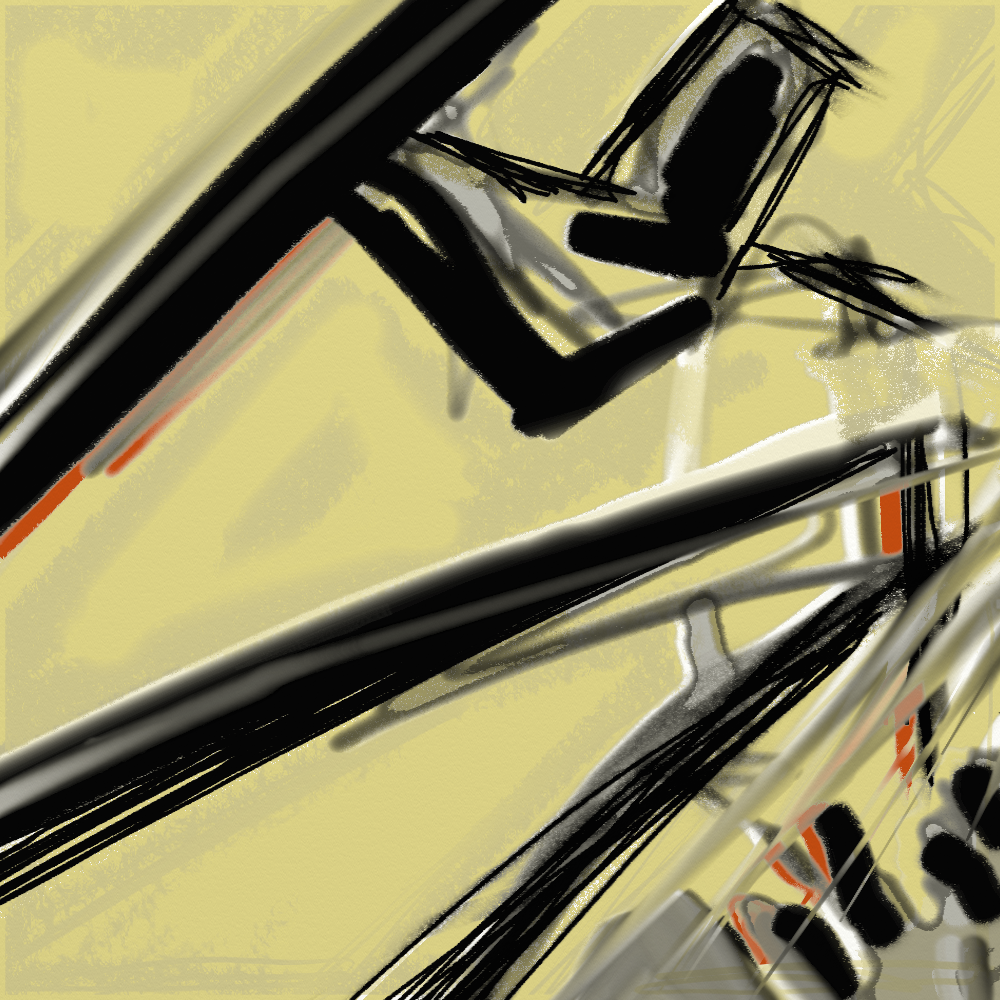
making time

I love the process. I am so familiar with the tools – the software and the M200.

I have my eye on an iPad. It will not have the pressure sensitivity. What it will have is mobility. It is so sad that MS did not have the ability to develop the Tablet. The Toshiba M200 is small enough, but impossible (for me at least) to master when folded into its slate form. And the battery life is measured in minutes even with my new battery. There is still IMO a place in the market for MS to make a Windows 7 convertible. I am over my initial iPad disdain. I am appreciating Apple’s solid building and pragmatics combine with the revolutionary. They took over the music industry even though they came in late to the mp3 market, not a mean feat brilliant strategies!

Tools evolve, and the best use of any given tool is of value. I have done a lot of sketching on my Palm PDAs – tool I’ll never use again – but therein lies something of value. The lead pencil has no colour. But look what has been done over the centuries with the humble pencil, and it lives. The current – no pressure iPad will die and be gone, but I look forward to making use of it, while it is in its first iteration. What can the finger do on that thing?

Here are some examples, some good stuff there.

✔ July 2021

Fourth Wall

I recently learned this bit of theatre jargon.  Psychodrama obliterates the fourth wall, and at the same time totally makes the distinction between audience and stage.

Fourth wall – Wikipedia, the free encyclopedia:

The fourth wall is the imaginary “wall” at the front of the stage in a traditional three-walled box set in a proscenium theatre, through which the audience sees the action in the world of the play.[1][2] The idea of the fourth wall was made explicit by Denis Diderot and spread in nineteenth century theatre with the advent of theatrical realism,[3] which extended the idea to the imaginary boundary between any fictional work and its audience.

The presence of the fourth wall is an established convention of fiction and drama, which has led some artists to draw direct attention to it for dramatic or comedic effect. When this boundary is “broken”, for example by an actor onstage speaking to the audience directly, or doing the same through the camera in a film or television program, it is called “breaking the fourth wall.”[1][4]

There is no such thing as a person

Winnicott famously said “there is no such thing as a baby.” (reference?) meaning of course there is always a baby and someone. Jacob Moreno’s notion of a social and cultural atom (reference?) is similar and more startling. There is a minimum set of roles (interactions) that need to be present for survival. In other words there is no such thing as a mother either, there is always a mother and a father (absent or not). The reference to role systems and dynamics is important here. We are not talking about people but relationships and ways of relating. People who don’t do anything are dead. Primacy of the relationship is not an uncommon idea in psychotherapy, even when the word ‘object’ is used in some schools of therapy, it is the ‘object relations’ that are important. For all that it is a big mind-shift to go from the every-day world of things and entities into the psychological world of dynamics.

The physical body, physical reality, so easily belies psychologically potent reality. Psychodrama has the power to reveal all the subtle bodies usually invisible, the use of the term surplus reality facilitates this. But even in psychodrama the mind-shift can be hard to make. Imagine a group of people, with their bodies invisible, see them as three dimensional movie programs of archetypal dramas, developmental processes and graphical depictions of experience of ecstasy & trauma in the cellular memory. The current state of warm-up is the movie that is playing right now. At any moment other movies could grab the screen, all the programs are networked. The body does not betray the soul, but it can fool us into thinking there is no soul. No wonder we have the idea of the eternal soul, it is collective, unconscious and interconnected back to the big bang.

The implications for psychotherapy are well known but difficult to fully implement. One potent central idea, is that the therapeutic relationship is the source of healing. Even that one, well established idea, standard in most definitions of psychotherapy, is always under threat by talk of dependency, measurable evidence, behaviour, genes, chemicals, brains. And of course the demand for reports and videos introduce more elements into the relationship. The third eye kills the dyad and creates a group. This may not be a bad thing if it were consciously embraced. If we said there is no such thing as a dyad, however it often advocated that the third presence should be ignored. “After a while we forget there is a video camera in the room.” Denial of surplus reality. In the face of all these onslaughts psychotherapy has survived, and the healing power of relationship is constantly experienced and valued.

Social atom repair is the essence of therapy. In therapy all too often people warm-up to working on the relationship with the mother, and then later the father. As a psychodramatist I work, even in one-to-one settings with the idea of repairing the social atom. Whatever the medical mental health diagnosis people come with, it is, at the the core ,relationship difficulties. DSM style diagnosis are always blind to the psychological as they are totally fooled by and perpetuates the idea individual people. Those difficulties are present in the parental dyad in some form. An investigation of the role system in the parental dyad often sheds light on the current relationships. The most successful work I have done is where the “parents” enacted by the client, come to relationship psychotherapy. The client then, in the regressed state of the child, experiences their renewed parents. A new social and cultural atom is available to them.

This is similar to the TA idea or “re-parenting the parent”,  but taken to a relational level.

Couple therapy, working directly with a relationship follows from the fundamental idea of a dynamic psyche. Yet therapists often talk of individual work as needed for a healthy relationship. Harville Hendrix’s Imago therapy, and Moreno and psychodrama before it, as well as all forms of family therapy with a systemic approach are more in tune with the psychological reality. Making the ‘imago’, the unconscious images operating in the relationship, the unit of therapy is a major breakthrough in psychotherapy. Hendrix’s phrase “The purpose of marriage is to heal childhood wounds.” (reference?) is profound. If we, in the psychotherapy field, embraced this we would use the healing potential in the couple relationship rather than the therapeutic relationship for psychological repair far more than we do.

Individuals are a myth. What is significant is ‘surplus’ to the physical entities, it is imaginal, relational and systemic.

Role of the Therapist with Couples

There is a continuum with two extremes.

Its all in the dialogue between the couple
Education is the main focus.
____________________________________ Its all in the safety of the relationship with the therapist. The therapeutic relationship with each partner and the relationship is the main focus.

Of course it is both, I doubt anyone holds the extreme positions. However it is an interesting question as to when one of these aspects needs to be to the fore.

This discussion with Rick & Sherry Stolp addresses this question very well, among other things.

Click to play & downloadListen or download here

Rick Stolp website


__________________________________________________

Later : Saturday, 6 October, 2012

I have further clarified that there are some criteria that indicate readiness for dialogue. The ability to move from adversarial positions is required for a dialogue. We do not want to foster something that is dialogical in form but adversarial in essence. As dialogues involve mirroring, the psychodrama principle that doubling comes before mirroring comes into play.

The therapist may be needed to double the couple for some time. Longer work is indicated for them to get to the dialogue stage.

__________________________________________________

Later: Sunday, October 17, 2010

About 20 minutes into the audio they talk about research based on ideas of “Duncan & Miller” on outcome research. http://www.talkingcure.com.

They now have separate websites:

Scott D Miller
http://www.scottdmiller.com
http://www.centerforclinicalexcellence.com

Barry Duncan
http://www.heartandsoulofchange.com
http://www.whatsrightwithyou.com

I’ve made another post on Outcome research here.